


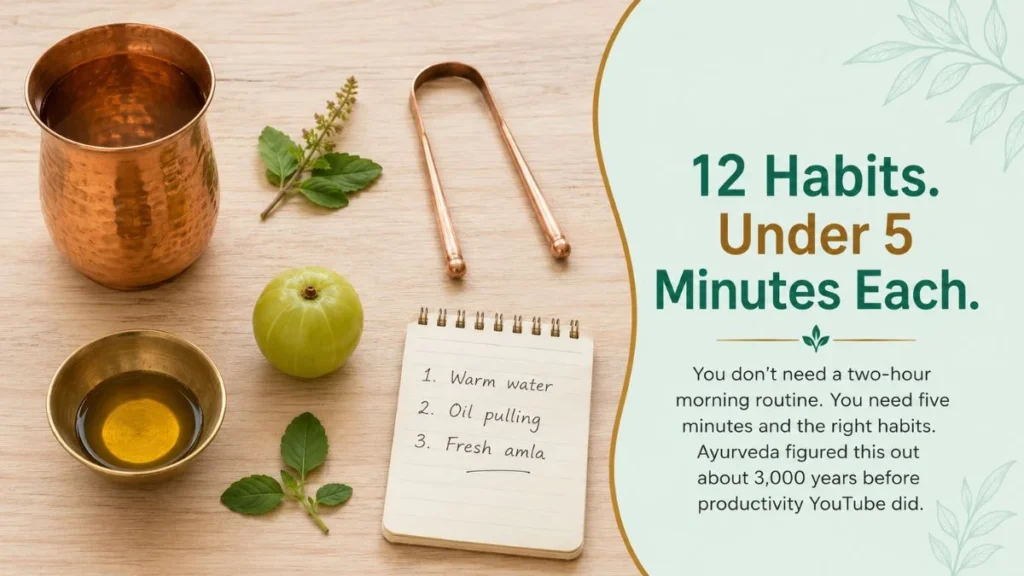
12 Ayurvedic Daily Habits That Take Under 5 Minutes (And Actually Make a Difference)
By a health and Ayurveda writer with 10+ years of practice | Updated June 2026 | 8 min read
You don’t need to overhaul your entire life. You don’t need a 90-minute morning ritual that requires waking up at 4:30am and owning a gong.
You need about five minutes. And the right Ayurvedic daily habits.
I’ve been practising Ayurveda for over a decade, and the things that have made the most consistent difference in my digestion, sleep, and stress aren’t the elaborate protocols. They’re the tiny ones — the 30-second tongue scrape, the warm water rule, the sesame oil on my feet before bed. Things so simple you almost dismiss them. Until you actually do them for two weeks and notice something shift.
Here are 12 of them. Each takes under 5 minutes. Each has at least some science behind it. And each one I’ve personally done long enough to have an honest opinion about.
Pick two. Start there. That’s it.
Morning Habits (Before You Touch Your Phone)
1. Warm Water First — From a Copper Vessel If You Can
Fill a copper vessel (Tamra Jal, meaning “copper water”) the night before. Drink it warm first thing in the morning — before tea, before coffee, before your phone.
Why it works: Warm water stimulates peristalsis — the muscular contractions that move food through your gut. A 2016 study in the Journal of Health, Population and Nutrition found that copper surfaces reduce bacterial contamination by over 97% within 8 hours. (Source: PubMed) The Ayurvedic reasoning: warm water kindles Agni (digestive fire). The practical result: things move in the morning.
I’ve been doing this for about six years. On mornings I skip it, I notice. A decent copper vessel costs ₹400–800 / $8–15 and lasts forever.
2. Tongue Scraping — 30 Seconds, Non-Negotiable
Use a curved copper or stainless steel tongue scraper. Five gentle strokes, back to front, first thing after waking. Rinse after each stroke.
Why it works: Overnight, bacteria, dead cells, and food debris accumulate on the tongue surface — this coating is called Ama (toxin residue) in Ayurveda. A study in the Journal of Periodontology confirmed that tongue scraping reduced volatile sulphur compounds (bad breath markers) significantly more effectively than brushing the tongue alone. Your toothbrush literally can’t do what a scraper does.
Cost: ₹100–200 / $3–5. One purchase. Lasts years. I genuinely don’t understand why this isn’t taught in schools.
3. No Screens for the First 10 Minutes
This isn’t traditional Ayurveda — this is Ayurvedic logic applied to modern life. The Charaka Samhita (one of the foundational classical Ayurvedic texts, compiled around 300–200 BCE) describes the first hour after waking as a Vata-dominant period — the nervous system is most impressionable and easily agitated.
Why it works: Reaching for your phone in the first 10 minutes floods your barely-awake prefrontal cortex with cortisol-triggering stimuli before it’s ready to process them. A 2023 survey by the American Psychological Association found that people who checked news or social media within 10 minutes of waking reported higher anxiety throughout the day.
I failed at this for two years before making it stick. The trick that worked: putting my phone in the kitchen, not beside my bed. Sounds obvious. Took me embarrassingly long.
4. Three Minutes of Anulom Vilom
Anulom Vilom (alternate nostril breathing, a form of Pranayama meaning “breath control”) — close right nostril, inhale through left for 4 counts. Close left, exhale through right for 4 counts. Reverse. Repeat for 3 minutes.
Why it works: Alternate nostril breathing balances sympathetic and parasympathetic nervous system activity. A 2013 study in the Journal of Clinical and Diagnostic Research found it significantly reduced anxiety scores in just 6 weeks of practice. Three minutes. Free. No equipment. No app subscription. Just your fingers and your nose.
I do this before my first meeting of the day. It’s the cheapest anti-anxiety intervention I’ve ever tried — and arguably the most effective.
Eating Habits (Small Rules, Big Difference)
5. Eat One Amla Daily
One fresh Amalaki (Indian gooseberry, Amla) — raw, pickled, or as dried candy. That’s it.
Why it works: Amla has one of the highest natural vitamin C concentrations of any fruit — roughly 600–700mg per 100g. It’s also rich in polyphenols and gallic acid. Research in the European Journal of Clinical Nutrition found that regular Amla consumption improved endothelial function and reduced oxidative stress markers. (Source: PubMed) My grandmother ate one every morning for decades. I used to think it was a quirk. It wasn’t.
Fresh Amla: ₹5–10 per fruit. Dried Amla candy: ₹60–120 for a jar. No excuses on cost here.
6. Eat Your Largest Meal Before 2pm
Ayurveda says your Agni (digestive fire) peaks when the sun is highest — roughly between 12pm and 2pm, the Pitta time of day.
Why it works: Modern chronobiology agrees. A 2013 study in the International Journal of Obesity found that participants who ate their main meal before 3pm lost significantly more weight than late eaters — even with identical calorie intake. Your metabolic enzymes, bile secretion, and insulin sensitivity are all highest around midday. Eating a heavy dinner at 9pm is basically asking your body to run its weakest digestive machinery on the hardest job.
I shifted my big meal to lunch about three years ago. Evening bloating vanished within two weeks. Not subtle.
7. Warm Water with Meals — Never Cold
Sip warm or room-temperature water with your food. Avoid ice water or cold beverages during meals.
Why it works: Cold water constricts blood vessels in the stomach lining, slowing gastric motility and enzyme activity. Ayurveda frames this as cold water “dousing” your Agni. Modern gastroenterology confirms that warm fluids enhance gastric emptying. I know this sounds like something an aunty would insist on at a family dinner — but the aunty was right. She usually is.
8. Sit Down to Eat — Always
Not at your desk while scrolling. Not standing at the kitchen counter. Sit. On a chair or cross-legged — either works. Focus on the food.
Why it works: Eating while standing or distracted increases air swallowing (aerophagia) and reduces satiety signalling — you eat more and digest worse. Ayurveda considers eating posture and mental state as important as the food itself. The Charaka Samhita specifically lists “eating while distracted” as a cause of Ama accumulation. Sounds extreme. But when I actually started sitting properly for every meal — including snacks — the post-meal heaviness I’d normalised for years quietly disappeared.
Evening and Bedtime Habits (Where Recovery Happens)
9. Sesame Oil on Your Feet Before Bed
Warm a small amount of cold-pressed sesame oil between your palms. Massage the soles of both feet for 2–3 minutes before bed. Put on cotton socks if you don’t want oil on your sheets.
Why it works: The soles of the feet contain over 7,000 nerve endings. In Ayurveda, the feet are considered a primary Vata (air and space energy) site — massaging them with warm oil is the classical approach to calming an agitated nervous system before sleep. Modern reflexology research supports the connection between foot massage and reduced anxiety and improved sleep quality.
I was sceptical about this one. Properly sceptical. I tried it for two weeks because my sleep was bad enough that I was willing to try anything — and my sleep onset genuinely improved. Was it the oil? The massage? The act of slowing down before bed? I think it’s all three. Cost: ₹150–300 / $3–5 for a bottle that lasts two months.
10. Triphala at Bedtime
Half a teaspoon of Triphala churna (a classical combination of three fruits — Amalaki, Bibhitaki, and Haritaki) in warm water, 1–2 hours after dinner.
Why it works: Triphala acts as a gentle prebiotic, feeding beneficial gut bacteria and supporting smooth morning elimination without the cramping that stimulant laxatives cause. A 2022 study in BMJ Open Gastroenterology confirmed significant increases in beneficial Bifidobacteria and Lactobacilli after Triphala supplementation. Tastes like bitter earth. Gets easier. Works.
Cost: ₹80–200 / $3–6 for a 100g jar that lasts over a month.
Triphala for Gut Health: What It Does Inside Your Body (2026)
11. Left Nostril Breathing for Calm
Close your right nostril with your thumb. Breathe slowly through your left nostril only — 10 breaths, each exhale longer than the inhale. Takes about 90 seconds.
Why it works: In Ayurvedic and yogic physiology, the left nostril is associated with the Ida Nadi (the cooling, calming energy channel). In modern terms, left-nostril-dominant breathing preferentially activates parasympathetic nervous system activity. A small study in the Indian Journal of Physiology and Pharmacology found it reduced systolic blood pressure and heart rate. I use this in bed when my mind won’t shut up. Works in about 60 seconds — faster than melatonin, cheaper than a sleep app.
12. Gratitude Journaling — Three Lines, 60 Seconds
Open a notebook. Write three things you’re genuinely grateful for from today. Close the notebook. Done.
Why it works: A 2019 study in the Journal of Happiness Studies found that participants who wrote gratitude entries for just 3 weeks showed measurable improvements in well-being and reduced depressive symptoms. Ayurveda considers this a Sattva (mental clarity and balance) practice — it shifts the mind’s attention from deficit to sufficiency. I’ve been doing this for about two years. Some nights I write “good dal for dinner” and that’s enough. It’s not the depth of the gratitude that matters — it’s the consistency.
Cost: ₹40 for a ruled notebook. ₹0.67 per night if you use one page per week. The economics are hard to argue with.
I Tried Ayurvedic Stress Remedies for 30 Days — Here Is My Completely Honest Review
⚠ A Quick Note on What These Habits Won’t Fix
These are daily wellness habits. They support good digestion, better sleep, and lower baseline stress. They do not treat medical conditions.
If you have persistent digestive issues, chronic insomnia, or anxiety that’s affecting your daily functioning — please see a qualified medical professional. These habits can complement treatment, but they don’t replace it.
⚠ Triphala should be avoided during pregnancy and by those on blood-thinning medication. Copper water vessels should be cleaned regularly and are not recommended for people with Wilson’s disease. If you have any medical condition, consult your doctor before adding supplements or new practices.
How to Start — Pick 2. Just 2. This Week.
If you try to do all 12 starting tomorrow, you’ll do them for four days and then abandon everything. I know because I’ve done exactly that — more than once.
Here’s what I’d suggest:
- This week: Pick one morning habit and one evening habit. My recommendation: tongue scraping (morning) + sesame oil feet massage (evening). Total investment: ₹300 / $6. Total daily time: under 4 minutes.
- Next week: Add warm water first thing. Put a copper vessel by your bed tonight. Fill it before you sleep.
- Week 3: Add one eating rule — either “sit to eat” or “warm water with meals.” These cost nothing and require zero equipment.
Two habits at a time. Let them become automatic before adding more. That’s how Ayurvedic daily habits actually stick — not through motivation, but through rhythm.
What is Vata, Pitta, and Kapha — a beginner’s guide to Ayurvedic body types
Quick Reference — Screenshot This
| # | Habit | Time | Cost |
|---|---|---|---|
| 1 | Warm copper water on waking | 1 min | ₹400–800 once |
| 2 | Tongue scraping | 30 sec | ₹100–200 once |
| 3 | No screens for 10 minutes | 0 min | Free |
| 4 | Anulom Vilom breathing | 3 min | Free |
| 5 | One Amla daily | 1 min | ₹5–10/day |
| 6 | Biggest meal before 2pm | 0 min | Free |
| 7 | Warm water with meals | 0 min | Free |
| 8 | Sit down to eat | 0 min | Free |
| 9 | Sesame oil feet massage | 3 min | ₹150–300/bottle |
| 10 | Triphala at bedtime | 1 min | ₹80–200/jar |
| 11 | Left nostril breathing | 90 sec | Free |
| 12 | Gratitude journaling (3 lines) | 60 sec | ₹40/notebook |
5 of 12 habits are completely free. 7 of 12 take under 2 minutes. The economics and the time investment here are basically impossible to argue against.
You Don’t Need a New Lifestyle. You Need a Few Better Habits.
Here’s what I’ve learned from a decade of testing Ayurvedic daily habits: the ones that last aren’t the impressive ones. They’re the small, slightly boring, easy-to-dismiss ones that you do so often they stop requiring willpower.
Tongue scraping. Warm water. Sitting down to eat. Sesame oil on your feet. None of these will trend on Instagram. All of them will quietly improve how your body feels over the next 30 days.
Ayurveda has been refining these micro-habits for three thousand years. The fact that modern research keeps arriving at the same conclusions — about meal timing, about breathwork, about the gut microbiome — tells you something about the system that produced them.
Pick two. Start tonight. Forward this to someone who needs it.
Which two are you starting with?
What Is Your Dosha? 3 Ancient Body Types Explained Beyond the Quiz
Frequently Asked Questions
Do I need to do all 12 Ayurvedic daily habits?
No. Start with 2 — one morning habit and one evening habit. Let them become automatic over 2–3 weeks before adding another. Trying to implement all 12 at once is the fastest way to abandon all 12. Ayurveda is a long game, not a sprint.
Is copper water actually safe?
For most healthy adults, yes — storing water in a copper vessel overnight is safe and is supported by research showing antimicrobial properties. Clean the vessel regularly with lemon and salt. Avoid copper water if you have Wilson’s disease or copper sensitivity. Don’t store anything acidic (like lemon juice) in copper for extended periods.
Can I do Anulom Vilom if I have a blocked nose?
If one nostril is mildly congested, you can still practise gently — the breathing often clears the blockage after a few rounds. If both nostrils are significantly blocked due to a cold or sinus infection, skip the practice until you recover. Never force the breath.
Why sesame oil specifically for the feet?
Sesame oil is considered the primary Vata-pacifying oil in Ayurveda — warm, heavy, and grounding. It also has the highest antioxidant content of common cooking oils. Coconut oil is an alternative for people with Pitta-dominant constitutions (it’s cooling), but for general use, sesame is the classical recommendation.
How long before I notice results from these habits?
The immediate habits (tongue scraping, warm water, breathwork) show effects within days. The cumulative habits (meal timing, Triphala, foot massage) typically take 2–3 weeks before the difference becomes noticeable. In my experience, the full compound effect — where everything starts working together — kicks in around week 3–4.
References and Sources
- Grass G, Rensing C, Solioz M. (2011). Metallic copper as an antimicrobial surface. Applied and Environmental Microbiology. PubMed
- Usharani P, et al. (2014). Effects of Phyllanthus emblica extract on endothelial dysfunction. European Journal of Clinical Nutrition. PubMed
- Garrido M, et al. (2013). Influence of lunch time on weight loss. International Journal of Obesity.
- Charaka Samhita — Sutra Sthana, Chapter 5 (on Dinacharya — daily conduct)
- Charaka Samhita — Sutra Sthana, Chapter 27 (on Agni and digestion)
Medical Disclaimer
This article is for informational and educational purposes only. It is not intended to be a substitute for professional medical advice, diagnosis, or treatment. Always seek the advice of your physician or other qualified health provider with any questions you may have regarding a medical condition. Never disregard professional medical advice or delay seeking it because of something you have read here.
The Ayurvedic herbs and practices described in this article may not be suitable for everyone. Consult a qualified Ayurvedic practitioner or medical doctor before beginning any new supplement or practice, particularly if you are pregnant, breastfeeding, taking prescription medications, or managing a pre-existing health condition. Ayurvedic treatments are intended to complement — not replace — standard medical care.
