


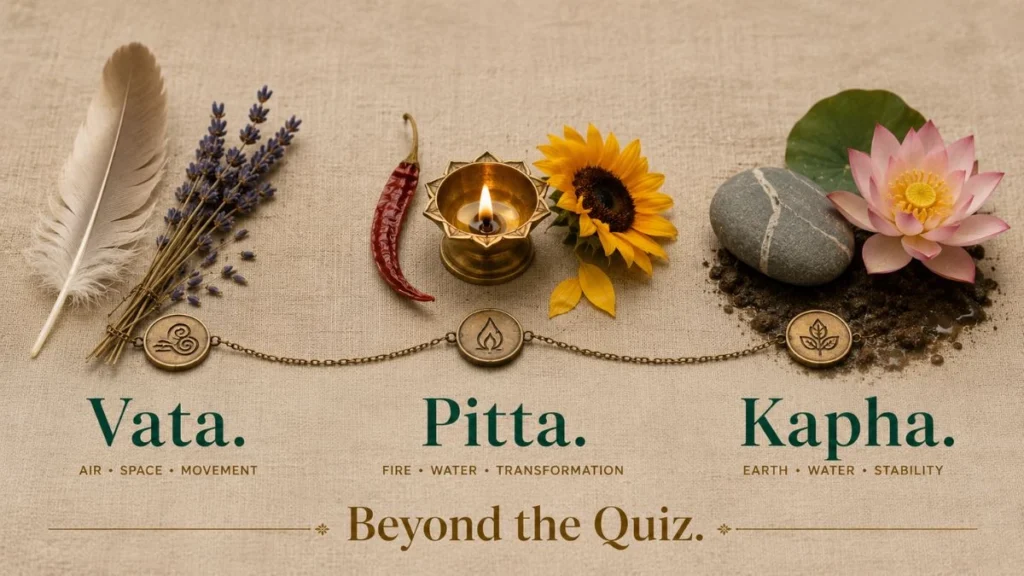
What Is Your Dosha? A Practical Guide That Goes Beyond the Quiz — 3 Body Types That Actually Help You
Published June 19, 2026 · Ayurveda Pillar Article · ~2,500 words · 11 min read
I’ve taken at least fifteen dosha quizzes over the past decade. I’ve been told I’m Vata. I’ve been told I’m Pitta. Once — during a particularly stressful January — I scored as Kapha, which made me laugh because I weigh 65 kilos soaking wet and have never been described as “stable and grounded” by anyone who knows me.
So — what is your dosha, really? And why do those quizzes keep giving different answers?
The short answer: most dosha quizzes are measuring the wrong thing. They’re asking how you feel right now. They should be asking who you’ve been your entire life. These are profoundly different questions. And confusing them is where almost everyone — including me, for two years — goes wrong.
This guide is what I wish someone had explained to me before I spent those two years eating the wrong foods for my actual constitution. It’s based on the classical Ayurvedic texts, conversations with three different BAMS-qualified practitioners, and my own slow, sometimes embarrassing learning process.
Why Most Dosha Quizzes Get It Wrong — And What to Ask Instead
Here’s the fundamental problem. Every online quiz asks you a version of: “Do you tend to feel anxious or calm? Is your skin dry or oily? Do you prefer hot or cold weather?”
And you answer based on right now. Based on this week. Based on the season you’re in, the stress you’re under, the food you ate yesterday.
But that’s not what your dosha is. That’s what your dosha is doing today. Ayurveda makes a critical distinction that most online content completely ignores.
Prakriti vs. Vikriti: What Is Your Dosha at Birth vs. Right Now?
Prakriti (your birth constitution) is the dosha combination you were born with. It was determined at conception — by your parents’ constitutions, your mother’s diet and emotional state during pregnancy, and the season and conditions of your birth. Your Prakriti never changes. Not with age, not with diet, not with climate. It’s your baseline. Your factory setting.
Vikriti (your current state) is which doshas are elevated or depleted right now — due to stress, season, diet, sleep patterns, emotional state, or illness. Vikriti changes constantly. It shifts with the weather. It shifts with your job. It shifts with what you ate for dinner.
Here’s why this matters: most quizzes measure Vikriti and call it Prakriti. So when you take a quiz during a stressful period, you score high Vata (anxiety, restlessness, insomnia). Take the same quiz in summer after a holiday, and you might score Pitta (sharp, focused, overheated). Neither result tells you your actual constitution. Both results tell you what’s happening this week.
I learned this the hard way. For two years, I ate a Pitta-balancing diet — cooling foods, less spice, more raw salads — because I took a quiz during a high-pressure work phase and scored strongly Pitta. Turns out I’m Vata-Pitta, with Vata dominant. I was feeding myself raw, cold food that was increasing my Vata imbalance, not calming it. My digestion got worse. My anxiety increased. It took a proper consultation with a practitioner in Mysuru to sort out what was actually going on.
The 3 Doshas in Real Life — Not the Textbook Version
Every Ayurveda article describes the doshas using element theory. Vata is air and space. Pitta is fire and water. Kapha is earth and water. And that’s accurate — but not useful until you see what it looks like in an actual person living an actual life.
Here’s how to recognise each dosha not by reading a quiz, but by watching yourself over time.
Vata: The Quick, Light, Variable Pattern
Vata is the dosha of movement — air and space. If Vata is dominant in your Prakriti, you’ll recognise these lifelong patterns (not just current tendencies):
- Body frame: Naturally thin, light-boned, finds it hard to gain weight even when eating well. Long fingers, prominent joints. (“Eat more!” is something people have said to you your whole life.)
- Digestion: Irregular and unpredictable — some days ravenous, other days no appetite at all. Prone to gas, bloating, and constipation, particularly when stressed.
- Sleep: Light sleeper. Wakes easily. Often awake between 2–4 AM with racing thoughts. Needs more sleep than other types but gets less of it. [INTERNAL LINK: Exhausted but can’t sleep — Ayurvedic explanation]
- Mind: Quick-thinking, creative, enthusiastic — but also anxious, scattered, and prone to overwhelm. Starts many projects, finishes fewer. [INTERNAL LINK: Ayurvedic approach to anxiety]
- Skin and hair: Tends toward dry skin and dry, thin hair. Cold hands and feet, especially in winter.
- Social style: Talkative when comfortable, but energy fluctuates unpredictably. Can go from enthusiastic to withdrawn within the same day.
I am predominantly Vata. And reading that list for the first time — in a proper Ayurvedic textbook, not a quiz — was one of those uncomfortable moments where you feel seen in a way you didn’t ask for. The 2–4 AM waking. The half-finished projects. The cold hands. All of it. Since childhood.
Pitta: The Sharp, Driven, Overheated Pattern
Pitta is the dosha of transformation — fire and water. Pitta-dominant people are recognisable by their intensity.
- Body frame: Medium build, moderate weight, muscular when active. Warm body temperature — these are the people who wear a t-shirt when everyone else is in a jumper.
- Digestion: Strong and reliable. Pitta types get angry when they miss a meal. (If someone around you becomes irritable precisely at mealtimes, they’re probably Pitta.) Prone to acid reflux, heartburn, and loose stools when imbalanced.
- Sleep: Generally good sleepers — fall asleep easily, sleep soundly. But tend to sleep less than they need because they’d rather be doing something productive. [INTERNAL LINK: Ayurvedic sleep remedies]
- Mind: Organised, focused, ambitious, competitive. Excellent at follow-through. But also prone to perfectionism, impatience, criticism, and a temper that flares quickly and burns out fast.
- Skin and hair: Tends toward sensitive, warm skin that reddens easily. Prone to acne, rosacea, inflammation. Often premature greying or early hair thinning.
- Social style: Direct, assertive, sometimes blunt. Natural leaders. Difficult to argue with — not because they’re always right, but because they’re always certain they are.
My partner is Pitta-dominant. The mealtime anger is real. I once saw her go from cheerful conversation to “I can’t talk to you right now” in about twelve minutes because lunch was delayed. Not emotional. Physiological. Her fire needed fuel.
Kapha: The Steady, Grounded, Slow-to-Change Pattern
Kapha is the dosha of structure — earth and water. Kapha-dominant people are the anchors in every room.
- Body frame: Larger, heavier frame. Gains weight easily, loses it with difficulty. Strong, well-padded joints. Good physical endurance once they get moving.
- Digestion: Slow but steady. Can skip meals without distress (unlike Pitta). Prone to sluggish digestion, heaviness after eating, and weight gain from overeating — especially sweet, heavy foods. [INTERNAL LINK: Gut health and mental health connection]
- Sleep: Deep, heavy sleepers. Can sleep 9–10 hours easily and still feel groggy in the morning. Hardest to wake up. Prone to oversleeping and daytime lethargy when imbalanced.
- Mind: Calm, patient, compassionate, loyal. Excellent long-term memory. Slow to learn but retains everything once learned. Prone to attachment, possessiveness, resistance to change, and depression (not anxiety — that’s Vata) when imbalanced.
- Skin and hair: Thick, smooth, well-hydrated skin. Thick, lustrous hair. These are the people who look younger than their age well into their fifties.
- Social style: Steady, reliable, nurturing. The friend who remembers your birthday. Also the friend who takes three weeks to reply to a text message.
My mother is Kapha. She can sleep through a thunderstorm. She has never once been described as “restless.” And she has maintained the same daily routine, without deviation, for approximately thirty years. That’s Kapha.
Dual-Dosha and Tridoshic Types: What Most People Actually Are
Here’s something most “what is your dosha” content glosses over: pure single-dosha types are rare. The Charaka Samhita describes seven possible constitution types — three single (Vata, Pitta, Kapha), three dual (Vata-Pitta, Pitta-Kapha, Vata-Kapha), and one tridoshic (all three roughly equal).
Most people are dual-dosha. Most.
| Constitution Type | Frequency | Characteristics | Common Imbalance Pattern |
|---|---|---|---|
| Pure Vata | Uncommon | Very light, very variable, very creative, very anxious | Anxiety, insomnia, digestive irregularity |
| Pure Pitta | Uncommon | Intensely driven, warm, sharp-minded, sharp-tongued | Inflammation, acid reflux, burnout, anger |
| Pure Kapha | Uncommon | Very stable, very heavy, very calm, very resistant to change | Weight gain, lethargy, congestion, depression |
| Vata-Pitta | Very common | Creative + driven, thin + intense, anxious + perfectionist | Burnout, anxiety, acid reflux under stress |
| Pitta-Kapha | Very common | Strong + steady, muscular, determined, good stamina | Weight gain with inflammation, stubbornness |
| Vata-Kapha | Common | Anxious + lethargic, cold constitution, irregular energy | Congestion with anxiety, poor circulation |
| Tridoshic (Sama Prakriti) | Rare | Balanced across all three, adaptable, generally robust | Depends on environmental triggers |
I’m Vata-Pitta. The creative-but-anxious, thin-but-intense combination. My quiz results always bounced between the two because both doshas were showing up — they just took turns depending on the season and my stress level. It wasn’t until a practitioner in Mysuru assessed my bone structure, childhood patterns, and lifelong tendencies (not just my current symptoms) that we landed on Vata-Pitta with Vata leading.
That distinction — Vata-Pitta vs. Pitta-Vata — changed my dietary approach entirely. When Vata leads, you prioritise warming, grounding, regular routines. When Pitta leads, you prioritise cooling, calming, and moderation. Opposite strategies. Getting it backwards, as I did for two years, makes things worse.
How to Determine What Is Your Dosha — Without a Quiz
A proper Ayurvedic assessment involves Nadi Pariksha (pulse diagnosis), physical examination, and a detailed history — ideally by a BAMS-certified practitioner. But you can get a meaningful initial understanding on your own by asking the right questions.
Ask these — but answer based on your LIFELONG patterns, not this week:
- What was your body frame like as a child? Thin and light (Vata), medium and warm (Pitta), or sturdy and heavy (Kapha)? This doesn’t change.
- What is your bone structure? Narrow wrists, prominent joints (Vata)? Medium, proportional (Pitta)? Broad, thick joints (Kapha)? Bone structure is genetic, not lifestyle-dependent.
- How has your digestion been your whole life — not recently? Irregular and unpredictable (Vata)? Strong and demanding (Pitta)? Slow and steady (Kapha)?
- What happens to your sleep under stress? Can’t fall asleep, racing thoughts (Vata)? Fall asleep fine but wake early, mind already planning (Pitta)? Sleep more, harder to wake up, want to withdraw (Kapha)?
- How do you learn best — and forget? Quick to learn, quick to forget (Vata)? Moderate pace, good retention if interested (Pitta)? Slow to learn, never forgets (Kapha)?
- What does your emotional default look like under pressure? Anxiety, fear, overwhelm (Vata)? Anger, frustration, criticism (Pitta)? Withdrawal, stubbornness, emotional eating (Kapha)?
If you answer honestly — based on patterns you’ve noticed since childhood, not since Tuesday — two of the three doshas will clearly stand out. That’s probably your dual-dosha type. The one that shows up in bone structure and childhood patterns is almost certainly your leading dosha.
And if you’re still unsure — see a practitioner. A single proper consultation (typically ₹500–1,500 / ~$6–18 USD at most Indian Ayurveda clinics) will tell you more than fifty online quizzes ever could.
Seasonal Dosha Shifts: Why You Feel Different in Summer vs. Monsoon
Your Prakriti doesn’t change. But the doshas in the environment do — and they influence your Vikriti significantly. This is one of Ayurveda’s most practical insights, and it’s one most people miss when asking “what is your dosha.”
- Autumn + Early Winter (Oct–Jan): Vata accumulates. Cold, dry, windy weather aggravates Vata. Anxiety increases. Skin dries out. Sleep deteriorates. This is when Vata-dominant people feel worst. [INTERNAL LINK: Ashwagandha benefits and evidence]
- Late Spring + Summer (Apr–Jul): Pitta accumulates. Hot weather aggravates Pitta. Skin inflammation, irritability, acid reflux, and temper flare. Pitta-dominant people feel worst.
- Late Winter + Spring (Feb–Apr) and Monsoon (Jul–Sep): Kapha accumulates. Cold, damp weather aggravates Kapha. Congestion, heaviness, lethargy, weight gain, and low mood. Kapha-dominant people feel worst.
I tracked my own symptoms across twelve months and the pattern was stark. October through December — my worst months for anxiety, insomnia, and dry skin. Every year. Without fail. Vata season, Vata person, Vata symptoms. Once I started adjusting my diet and routine seasonally (more warm foods, more oil, earlier bedtime in autumn), those months became significantly more manageable. Not perfect. Manageable.
The Charaka Samhita devotes an entire chapter — Ritucharya — to seasonal routines for each dosha. It’s not a modern wellness concept. It’s a 3,000-year-old clinical protocol.
When Dosha Knowledge Is Not Enough — Seek Professional Help
Understanding your dosha is useful for daily habits, food choices, and self-awareness. It is not a diagnostic tool for medical conditions.
See a medical professional if:
- Digestive symptoms persist for more than 3 weeks despite dietary changes (could be IBS, IBD, or other conditions)
- Anxiety or low mood interfere with daily functioning — work, relationships, sleep
- Sleep problems persist despite good sleep hygiene (may need a sleep study)
- You experience unexplained weight loss or gain, fatigue, or pain
- Any symptoms worsen despite lifestyle changes
Knowing you’re Vata-dominant is helpful. Knowing you have generalised anxiety disorder requires a psychiatrist, not a dosha chart. Both pieces of information are useful. Neither replaces the other. [INTERNAL LINK: Signs you need professional help for anxiety]
🇮🇳 India:
• iCall (TISS): 9152987821 (Mon–Sat, 8 AM–10 PM)
• Vandrevala Foundation: 1860-2662-345 (24/7, multilingual)
🇺🇸 United States:
• 988 Suicide and Crisis Lifeline: Call or text 988 (24/7)
• Crisis Text Line: Text HOME to 741741
🇬🇧 United Kingdom:
• Crisis Text Line UK: Text HOME to 741741
Knowing your dosha is self-awareness. Seeking help when you need it is self-care.
How to Start Today — 3 Actions Based on Your Dosha Type
You don’t need a perfect diagnosis to start. Based on what you’ve read above, you probably already have a sense of which dosha leads for you. Pick the one that resonated most and try its single action for one week.
If you think you’re Vata-dominant:
Eat warm, cooked food for every meal this week. No cold smoothies, no raw salads for dinner, no iced drinks. Warm dal-rice, warm soups, warm chai with ginger. This single change — warm over cold — is the most impactful thing a Vata person can do immediately. Cost: ₹0 extra. Just change the temperature. [INTERNAL LINK: Daily Ayurvedic morning routine (Dinacharya)]
If you think you’re Pitta-dominant:
Eat your meals at exactly the same times every day this week — and do not skip lunch. Pitta’s fire needs consistent fuel. Also: reduce coffee to one cup before noon (this will be hard — Pittas love their coffee). Add coconut oil to your cooking instead of mustard oil. Include something sweet after lunch — a date, a few raisins, a small piece of jaggery. Sweet taste pacifies Pitta. Cost: ₹20–30/day extra at most.
If you think you’re Kapha-dominant:
Move your body for 20 minutes every morning before breakfast. A brisk walk, not gentle yoga (save that for evening). Kapha needs vigorous morning movement to overcome its natural inertia. Also: reduce portion sizes at dinner by one-third and eat by 7 PM. Light, warm dinners only. Skip the post-dinner snack. [INTERNAL LINK: Triphala benefits and how to use]
If you’re unsure — start here:
Book a single consultation with a BAMS-certified Ayurvedic practitioner. In India, this costs ₹500–1,500 (~$6–18 USD). Online consultations with qualified practitioners are available for ₹1,000–2,000 (~$12–24 USD). One session will answer the question “what is your dosha” more accurately than a lifetime of quizzes.
Your Dosha Is a Lens, Not a Label
If there’s one thing I’d want you to take from this guide, it’s this: what is your dosha is a useful question, but only if you use the answer as a lens for understanding yourself — not as a rigid identity box.
You’re not “a Vata.” You’re a person with Vata-dominant patterns who might need more warmth, more routine, more oil, and more grounding — especially in autumn. That’s useful, specific, actionable information. It’s not a horoscope.
The Charaka Samhita describes Prakriti assessment as the foundation of all Ayurvedic treatment. You cannot prescribe correctly if you don’t know the constitution. That’s why this article matters. That’s why a fifteen-question quiz — no matter how well-designed — will never replace a proper assessment of your lifelong patterns.
Start with the lifelong-pattern questions above. Try the single action for your likely dosha type this week. And if you want precision — see a practitioner. Your grandmother’s intuition about whether you “run hot or cold” is probably more accurate than any algorithm. Trust the pattern. Trust the lived observation. That’s what Ayurveda has always done.
Which dosha description made you uncomfortable because of how accurate it was? That’s probably your answer. I’d love to hear it.
Frequently Asked Questions
What is your dosha and how do you find it?
Your dosha is your Ayurvedic body-mind constitution — a unique combination of Vata (air and space), Pitta (fire and water), and Kapha (earth and water). Everyone has all three doshas, but in different proportions. The most accurate way to find your dosha is through a consultation with a qualified Ayurvedic practitioner (BAMS-certified) who assesses your pulse, physical characteristics, digestion patterns, sleep habits, and mental tendencies. Online quizzes can give a rough indication but often confuse your birth constitution (Prakriti) with your current imbalance (Vikriti).
What is the difference between Prakriti and Vikriti?
Prakriti is your birth constitution — the dosha combination you were born with, determined at conception. It never changes throughout your life. Vikriti is your current state of imbalance — which doshas are elevated or depleted right now due to diet, stress, season, lifestyle, or illness. Most dosha quizzes measure Vikriti without realising it, which is why your quiz results change every time you take one. Knowing both is important: Prakriti tells you your baseline tendencies, Vikriti tells you what needs attention right now.
Can you be more than one dosha type?
Yes — in fact, most people are. Pure single-dosha types (purely Vata, purely Pitta, or purely Kapha) are actually uncommon. The majority of people are dual-dosha types like Vata-Pitta, Pitta-Kapha, or Vata-Kapha, meaning two doshas are roughly equal and dominant. A small number of people are Tridoshic, with all three doshas in relatively equal balance. The Charaka Samhita describes seven possible constitution types, and dual-dosha combinations are by far the most common.
Why do dosha quiz results change every time I take one?
Dosha quiz results change because most quizzes measure your current state (Vikriti) rather than your birth constitution (Prakriti). If you take a quiz during a stressful work period, you will score high on Vata. If you take it during summer after overeating, you will score high on Pitta or Kapha. Your answers reflect how you feel right now, not who you fundamentally are. A proper Ayurvedic assessment looks at lifelong patterns — bone structure, childhood tendencies, consistent digestive patterns, and body frame — which do not change with mood or season.
Do doshas change with the seasons?
Your Prakriti (birth constitution) does not change, but doshas naturally accumulate and shift with the seasons. Vata increases in autumn and early winter (cold, dry, windy weather). Pitta increases in late spring and summer (hot weather). Kapha increases in late winter and early spring (cold, damp weather). This means a Vata-dominant person may feel more anxious in autumn, while a Pitta-dominant person may feel more irritable in summer. Ayurveda recommends adjusting diet and routine seasonally to counterbalance these natural shifts.
References
- Charaka Samhita, Vimana Sthana, Chapter 8 — Rogabhishagajitiya Vimana (Assessment of Patient Constitution). Description of seven Prakriti types and Nadi Pariksha. English translation by P.V. Sharma, Chaukhambha Orientalia.
- Charaka Samhita, Sutra Sthana, Chapter 6 — Tasyashitiya Adhyaya (Ritucharya — Seasonal Routines). Seasonal dosha accumulation and lifestyle protocols.
- Sushruta Samhita, Sharira Sthana, Chapter 4 — Description of Prakriti types and their characteristics. English translation by K.K.L. Bhishagratna.
- Ashtanga Hridaya, Sutra Sthana, Chapter 1 — Vagbhata’s description of dosha qualities, functions, and Prakriti determination. English translation by K.R. Srikantha Murthy, Chaukhambha Krishnadas Academy.
- Rotti, H., et al. (2014). “Determinants of Prakriti, the human constitution types of Indian traditional medicine and its correlation with contemporary science.” Journal of Ayurveda and Integrative Medicine, 5(3), 167-175. PubMed: 25336847
- Prasher, B., et al. (2008). “Whole genome expression and biochemical correlates of extreme constitutional types defined in Ayurveda.” Journal of Translational Medicine, 6, 48. PubMed: 18782426
The Ayurvedic herbs and practices described in this article may not be suitable for everyone. Consult a qualified Ayurvedic practitioner or medical doctor before beginning any new supplement or practice, particularly if you are pregnant, breastfeeding, taking prescription medications, or managing a pre-existing health condition. Ayurvedic treatments are intended to complement — not replace — standard medical care.
If you or someone you know is in mental health distress, please contact a qualified professional or one of the helplines listed above.
