


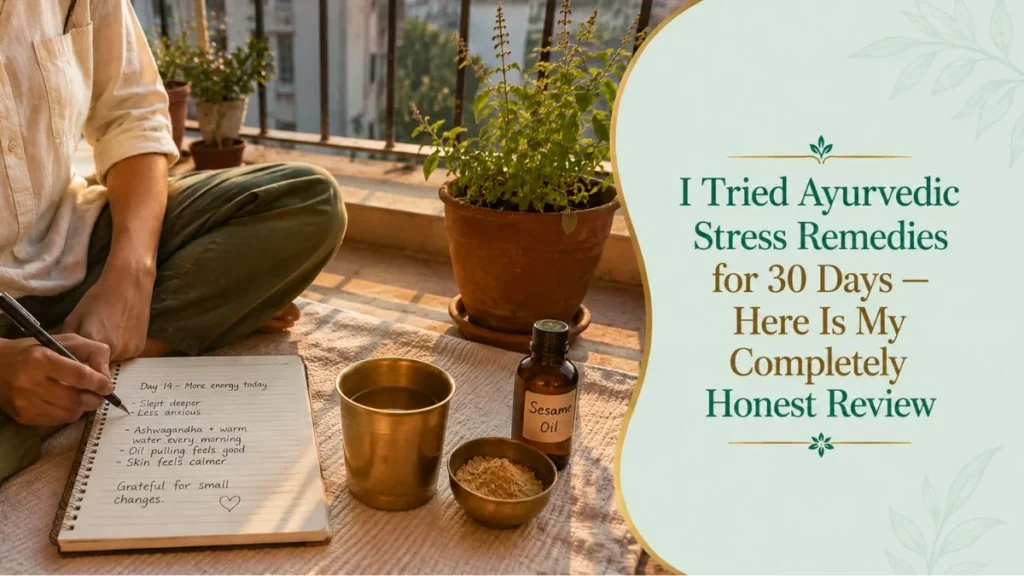
I Tried Ayurvedic Stress Remedies for 30 Days — Here Is My Completely Honest Review
By a health and Ayurveda writer with 10+ years of practice | Updated June 2026 | 9 min read
Last March, I hit a wall. Not a dramatic, cinematic breakdown — more like a slow erosion of everything working properly. Sleep was fractured. My attention span had shrunk to about eleven minutes. I was irritable over nothing and weirdly numb about things that should have mattered.
I’d been writing about Ayurvedic stress remedies for years. Recommending them. Citing the research. And yet, I realised with some embarrassment, I hadn’t actually committed to a proper, structured, daily protocol myself. Not properly. Not for more than a scattered week at a time.
So I decided to do it honestly. Thirty days. Five specific remedies. Tracked in a notebook every morning. And I promised myself I’d write about what actually happened — not what I hoped would happen.
This is my Ayurvedic stress remedies review. The real one. Including the parts that didn’t work.
The Five Remedies I Tested (And What They Cost Me)
I built the protocol in layers — starting simple in week one and adding components each week, the way a traditional Ayurvedic practitioner might recommend. Here’s what I used:
| Remedy | What It Is | When Started | Monthly Cost (INR / USD) |
|---|---|---|---|
| Ashwagandha (KSM-66, 600mg) | Adaptogenic herb for cortisol regulation | Week 1 | ₹750 / $12 |
| Abhyanga (warm sesame oil self-massage) | Daily oil massage — vagus nerve stimulation | Week 1 | ₹250 / $4 |
| Brahmi (300mg extract) | Cognitive support, anxiety reduction | Week 2 | ₹450 / $8 |
| Nadi Shodhana (alternate nostril breathing) | Pranayama practice — nervous system balancing | Week 2 | Free |
| Dinacharya (full daily routine) | Wake/sleep/eat/move at fixed times + no screens after 9pm | Week 3 | Free |
Total 30-day cost: approximately ₹2,400 (about $30 USD). That’s less than two sessions with a therapist in Bengaluru, or one month of a meditation app subscription. I’m not saying it replaces therapy — it doesn’t — but the economics are worth noting.
Week 1: Ashwagandha + Abhyanga — Starting Slow and Feeling Foolish
I started with two things only. Ashwagandha (Withania somnifera) — 300mg KSM-66 extract at night with warm milk. And Abhyanga (Ayurvedic warm oil self-massage) — 10 minutes with cold-pressed sesame oil before my morning shower.
Day 1 was awkward. I sat on a towel in my bathroom at 6:45am rubbing oil onto my shins while my flatmate walked past and gave me a look that I can only describe as “concerned but not enough to ask.” I felt mildly ridiculous. The oil smelled like a sesame-forward dosa batter.
By day 3, I’d stopped feeling silly and started noticing something: the first two hours of my morning were calmer. Not dramatically — subtly. The panicked reach for my phone was less automatic. Whether that was the vagus nerve stimulation from the oil massage or just the fact that I was doing something slow and intentional before exposing myself to the internet — I genuinely don’t know. Probably both.
Ashwagandha at night: no noticeable effect in week one. None. A 2012 RCT in the Indian Journal of Psychological Medicine showed significant cortisol reduction after 60 days, not 7 — so I wasn’t expecting miracles. (Source: PubMed) But I’m noting it because most people want to know: did you feel anything immediately? No. I did not.
Week 1 honest score: 4/10. Mostly felt like effort. Abhyanga was pleasant but hard to maintain. Ashwagandha was invisible.
Week 2: Added Brahmi and Nadi Shodhana — And My Sleep Shifted
Week two, I added Brahmi (Bacopa monnieri, 300mg standardised extract) with breakfast, and Nadi Shodhana (alternate nostril breathing, literally “channel-purifying breath”) — 5 minutes twice daily, morning and before bed.
The breathwork was the surprise. I’ve tried various breathing techniques before and mostly found them forgettable. But Nadi Shodhana at bedtime did something tangible: it slowed my thoughts down just enough that the gap between “getting into bed” and “actually falling asleep” shrank from about 40 minutes to roughly 15. A 2013 study in the Journal of Clinical and Diagnostic Research found it significantly reduced anxiety scores — and I can see why. It’s almost impossible to spiral about tomorrow’s to-do list when you’re concentrating on which nostril you’re breathing through.
Brahmi: harder to evaluate. I noticed slightly clearer mornings around day 10 — less of that foggy, dragging-my-brain-online feeling. But honestly, it could have been the better sleep doing that. I’m not confident enough to attribute it solely to the Brahmi, and I’d rather be honest about that than claim certainty I don’t have.
Week 2 honest score: 6/10. Sleep improving. Nadi Shodhana earning its place. Brahmi jury still out.
Weeks 3 and 4: Full Dinacharya — Where It All Clicked (Mostly)
Week three, I committed to full Dinacharya (the Ayurvedic daily routine, literally “daily conduct”). This meant:
- Wake at 5:45am — same time every day, including weekends (this was brutal)
- Abhyanga before shower
- Nadi Shodhana, 5 minutes
- Breakfast by 8am — warm, cooked (usually upma or poha with ghee)
- Lunch as the biggest meal, between 12:30 and 1pm
- Light dinner by 7:30pm
- Screens off by 9pm
- Ashwagandha with warm milk at 9:30pm
- Asleep by 10:15pm
Here’s what happened — and I need to say this carefully because I don’t want to sound like a converted zealot, but: by day 20, the cumulative effect was unmistakable.
My sleep was genuinely good. Not “adequate” — good. Seven-plus hours, falling asleep within 15 minutes, waking before my alarm feeling actually rested. This hadn’t been my baseline in over a year.
My digestion — which I hadn’t even listed as a target — improved noticeably. Less bloating after lunch. More regular mornings. I think the consistent meal timing did more for this than any single herb.
My focus at work improved somewhere around day 18. I noticed I could read for 30+ minutes without reaching for my phone. That sounds pathetic, and it is, but if you’ve been living with fractured attention for months, getting 30 minutes of unbroken reading feels like a superpower.
And stress? Here’s the honest part: my stress didn’t disappear. The situations causing it were still there — the deadlines, the difficult conversations, the financial uncertainty that comes with freelancing in Bengaluru. What changed was my response to the stress. The gap between “stressful thing happens” and “I react” got wider. I had a beat. A breath. That beat made all the difference.
Weeks 3–4 honest score: 8/10. The compound effect was real.
Ranked: What Actually Worked for My Stress (And What Didn’t)
- Dinacharya (fixed daily routine) — #1 by far. I genuinely believe this did more than any individual herb. The regularity — eating, sleeping, waking at the same times — settled my nervous system in a way that felt structural, not supplemental. The Charaka Samhita (one of the foundational Ayurvedic texts, compiled around 300–200 BCE) describes routine as the primary Vata-pacifying intervention. After 30 days, I understand why.
- Nadi Shodhana (breathwork) — #2. Fastest-acting of everything I tried. The bedtime sessions measurably improved my sleep onset. Free. No side effects. I’ll keep doing this indefinitely.
- Abhyanga (oil massage) — #3. The calming morning effect was consistent after week one. Messy. Time-consuming. Worth it. I’ve gone from daily to 4–5 times per week, which is more sustainable.
- Ashwagandha — #4. Did something, but it’s the hardest to isolate. By week 3 my stress reactivity was noticeably lower — but was that the Ashwagandha or the entire protocol? I suspect the herb contributed about 20% and the routine contributed 60%. Still worth including. Research supports cumulative cortisol reduction over 8+ weeks.
- Brahmi — #5. I’m genuinely unsure. My cognition improved, but I couldn’t separate the Brahmi effect from the better-sleep effect. I’m continuing it because the research on Bacopa and cognitive processing speed is reasonable, but I wouldn’t call this a clear individual win for me personally.
What Didn’t Work — And Why That’s Completely Fine
The no-screens-after-9pm rule lasted about 19 days. Then I had a project deadline and needed to work until 11pm, and after that the habit never fully recovered. I managed it about 4 nights out of 7 for the last ten days. I’m being honest about this because pretending I nailed a perfect protocol for 30 straight days would be a lie.
The 5:45am wake-up on weekends was miserable. I did it. I resented it. On day 22 (a Saturday), I slept until 7:30am and felt guilty for about ten minutes before deciding that guilt about sleep is probably not what Ayurveda intended.
And Ashwagandha gave me mild stomach heaviness in the first week when I took it on an empty stomach. Once I switched to taking it with warm milk — as traditionally recommended — the heaviness resolved within two days. Lesson: the traditional preparation instructions exist for a reason.
Ayurveda has a concept for this: Prakriti (your unique constitutional type). What works brilliantly for a Vata-dominant person may not hit the same for someone who’s primarily Pitta or Kapha. My protocol was heavily Vata-pacifying — warmth, oil, routine, grounding. If your stress pattern is more anger-driven and overheated (Pitta), or heavy and withdrawn (Kapha), you might need a different approach entirely.
⚠ When This Isn’t Enough — And You Need Professional Help
I want to be direct about this: my stress was the garden-variety, modern-life, too-much-work-not-enough-rest kind. It was real and disruptive, but it wasn’t clinical anxiety or depression.
If your stress has crossed into territory where it’s affecting your ability to function — persistent panic, emotional numbness lasting weeks, disrupted relationships, thoughts of self-harm — please see a mental health professional. Ayurvedic remedies can support recovery alongside treatment, but they are not a replacement for therapy or medication when those are needed.
⚠ Ashwagandha should be avoided during pregnancy, breastfeeding, and by those on thyroid or immunosuppressant medication. Brahmi may interact with sedatives. Consult your doctor before starting any supplement, especially if you’re on prescription medication.
Helplines — Please Use These
- iCall (TISS, India): 9152987821
- Vandrevala Foundation (India, 24/7): 1860-2662-345
- 988 Suicide and Crisis Lifeline (US): Call or text 988
- Crisis Text Line (US / UK): Text HOME to 741741
How to Apply This — If You Want to Try Your Own 30 Days
If any of this resonated, here’s how I’d structure a trial if I were starting again:
- Week 1: Pick just one thing — either Abhyanga (₹250/$4 for sesame oil) or Nadi Shodhana at bedtime (free). Don’t do everything at once. You’ll burn out on the burnout protocol.
- Week 2: Add Ashwagandha if you’re cleared by your doctor. KSM-66 extract, 300mg with warm milk at night. Himalaya, Organic India, or Setu in India — ₹500–900 for a month’s supply.
- Week 3: Set fixed wake, eat, and sleep times. This sounds boring. It is. It also works better than anything else I tried.
- Keep a notebook. Three lines per morning — how you slept, how you feel, one observation. This is what turned my vague “I think it’s working” into “I can actually see the pattern.” A ₹40 ruled notebook. Best investment in the whole protocol.
The Verdict: Would I Do It Again? Yes — But Not for the Reasons I Expected.
I went into this expecting the herbs to be the main event. Ashwagandha the hero, Brahmi the supporting actor. What I found was that the daily routine itself — the Dinacharya — was the real intervention. The herbs supported it. The breathwork accelerated it. But the structure held it all together.
Ayurveda didn’t fix my stress. My freelance life in Bengaluru is still chaotic. Deadlines still exist. But after 30 days of this Ayurvedic stress remedies review playing out in real time in my own body, I carry that stress differently. My nervous system has a floor now — a baseline it returns to — and that floor is lower and steadier than it was on day one.
Is this the best natural stress relief India has to offer? I don’t know. It’s what worked for me — a Vata-dominant person in his thirties living in south Bengaluru with a specific stress profile. Your Prakriti is different. Your life is different. Your mileage will absolutely vary.
But if you try it, track it honestly, and give it a real 30 days — I think you’ll learn something about yourself that no supplement label or review article can teach you.
Including this one.
What would your protocol look like? I’d genuinely love to know.
Frequently Asked Questions
Does Ayurveda actually work for stress?
In my experience — yes, but not the way most people expect. Individual herbs like Ashwagandha have clinical evidence for cortisol reduction over 8–12 weeks. But the biggest stress reduction came from the structured daily routine (Dinacharya) and breathwork (Nadi Shodhana), which are lifestyle interventions, not supplements. Ayurveda’s approach to stress is systemic — it treats the pattern, not the symptom.
How much does a 30-day Ayurvedic protocol cost?
My total was about ₹2,400 ($30 USD) — Ashwagandha (₹750), Brahmi (₹450), sesame oil (₹250), and the rest was free (breathwork, routine, screen discipline). Branded products from Himalaya, Organic India, or Setu are readily available across India and on Amazon globally.
How long before Ashwagandha starts working for stress?
I felt no noticeable effect in week one. Clinical trials typically show meaningful cortisol reduction after 60 days of consistent use at 300–600mg daily. It’s a slow recalibration, not an acute fix. If you’re expecting immediate relief, breathwork delivers faster.
Can I just take Ashwagandha without the other practices?
You can, and it may still help — the evidence supports standalone use. But in my experience, Ashwagandha alone delivered maybe 20% of the total benefit. The structured routine and breathwork contributed the rest. Ayurveda is designed as an integrated system, not a single-supplement protocol.
What is Dinacharya and why does it help stress?
Dinacharya is the Ayurvedic concept of a daily routine — fixed times for waking, eating, moving, and sleeping. The Charaka Samhita considers it the primary Vata-pacifying intervention. In modern terms, consistent circadian rhythm alignment reduces cortisol variability, improves sleep quality, and stabilises blood sugar — all of which directly lower baseline stress. It’s free. It’s boring. It works.
References and Sources
- Chandrasekhar K, et al. (2012). A prospective, randomized double-blind, placebo-controlled study of safety and efficacy of Ashwagandha root extract. Indian Journal of Psychological Medicine. PubMed
- Sharma K, et al. (2013). Effect of Nadi Shodhana pranayama on anxiety in medical students. Journal of Clinical and Diagnostic Research. PubMed
- Lopresti AL, et al. (2019). An investigation into the stress-relieving and pharmacological actions of an Ashwagandha extract. Medicine. PubMed
- Charaka Samhita — Sutra Sthana, Chapter 5 (on Dinacharya and daily conduct)
- Charaka Samhita — Sutra Sthana, Chapter 11 (on Vata dosha and mental agitation)
Medical Disclaimer
This article is for informational and educational purposes only. It is not intended to be a substitute for professional medical advice, diagnosis, or treatment. Always seek the advice of your physician or other qualified health provider with any questions you may have regarding a medical condition. Never disregard professional medical advice or delay seeking it because of something you have read here.
The Ayurvedic herbs and practices described in this article may not be suitable for everyone. Consult a qualified Ayurvedic practitioner or medical doctor before beginning any new supplement or practice, particularly if you are pregnant, breastfeeding, taking prescription medications, or managing a pre-existing health condition. Ayurvedic treatments are intended to complement — not replace — standard medical care.
If you or someone you know is in mental health distress, please contact a qualified professional or one of the helplines listed above.
