


Oura Ring vs WHOOP: 6 Months Wearing Both — Which Sleep Tracker Is Actually Worth It?
Published June 22, 2026 · Health: Trending Tech · ~2,500 words · 11 min read
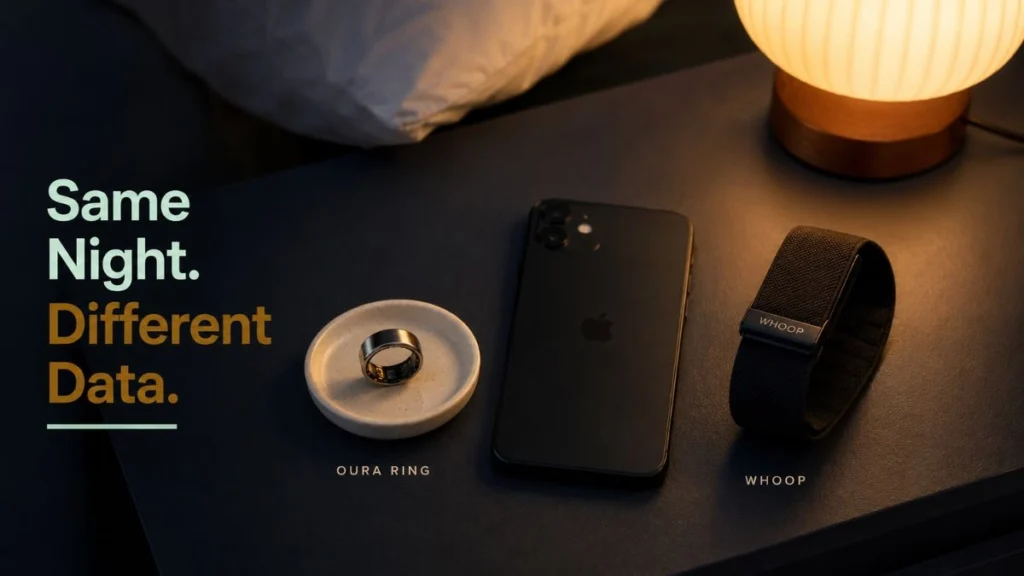
For the past six months, I’ve worn an Oura Ring Gen 3 on my left index finger and a WHOOP 4.0 on my right wrist. Same body. Same nights. Same pillow. Two devices, two apps, two algorithms — telling me two different stories about my sleep.
On one particular Tuesday in March — a night I slept well, felt rested, woke without an alarm — the Oura Ring vs WHOOP disagreement was absurd. Oura said I got 1 hour 42 minutes of deep sleep. WHOOP said 47 minutes. That’s a 55-minute gap. For the same night. On the same body.
So which one was right? The uncomfortable answer: probably neither, precisely. But that doesn’t mean they’re useless. And after 180 nights of dual-tracking, I have a clear opinion on which device earned its subscription and which one I’m cancelling. Here’s the full breakdown — with data, not vibes.
What Oura Ring and WHOOP Actually Measure — And How They Differ
Both devices measure sleep using the same fundamental sensors, but they do it differently. Understanding this explains why their data diverges.
Oura Ring Gen 3 measures:
- Photoplethysmography (PPG) — infrared light sensors in the ring measure blood flow through your finger arteries
- Heart rate + HRV (heart rate variability)
- Skin temperature variation (relative to your baseline)
- Movement (3D accelerometer)
- Blood oxygen (SpO2) — available but battery-intensive
WHOOP 4.0 measures:
- PPG — green and infrared LEDs on the wrist
- Heart rate + HRV
- Skin conductance (electrodermal activity)
- Skin temperature
- Movement (3D accelerometer)
- Blood oxygen (SpO2)
The critical difference is sensor placement. Oura reads from the finger. WHOOP reads from the wrist. Finger arteries are closer to the surface and less prone to motion artefacts, which is why research consistently shows that ring-form-factor devices tend to produce slightly more reliable heart rate and HRV data during sleep (Altini & Kinnunen, 2021).
WHOOP counters this with more sophisticated algorithms and continuous strain tracking throughout the day — something the Oura Ring doesn’t attempt. Same sensors, different form factors, different strengths.
Sleep Stage Accuracy: How Oura Ring vs WHOOP Compare to a Sleep Lab
Here’s the thing nobody selling you a sleep tracker wants to admit: no consumer wearable is highly accurate at detecting individual sleep stages. Not Oura. Not WHOOP. Not Apple Watch. Not any of them.
Polysomnography (PSG) — the gold-standard clinical sleep study — uses EEG electrodes placed directly on the scalp to measure brain waves. That’s how sleep stages are actually determined. Brain waves. Consumer wearables don’t measure brain waves. They measure heart rate patterns, movement, and temperature, then use machine learning algorithms to infer sleep stages from those signals.
A 2023 validation study found the following accuracy rates against PSG (Chinoy et al., 2023, Sleep):
| Metric | Oura Ring Gen 3 | WHOOP 4.0 | Clinical Significance |
|---|---|---|---|
| Total Sleep Time | ±15–20 min | ±20–30 min | Both adequate for tracking trends |
| Deep Sleep Detection | Overestimates by ~10–15 min | Variable — less consistent | Neither reliable for absolute values |
| REM Sleep Detection | Underestimates slightly | Overestimates by ~10–20 min | Neither reliable for absolute values |
| Wake Detection | Misses brief awakenings | Slightly better at detecting wakes | WHOOP marginal advantage |
| Heart Rate Accuracy | ±1–2 bpm (finger — excellent) | ±2–4 bpm (wrist — good) | Oura advantage due to finger placement |
| HRV Accuracy | Strong — correlates well with chest strap | Good — slightly more variable | Oura slight advantage |
| Temperature Tracking | Relative deviation — excellent trend data | Skin temperature — less granular | Oura advantage for illness / cycle detection |
The takeaway from my 180 nights of dual-tracking was consistent with the research: both devices are useful for trends, neither is trustworthy for individual-night precision on sleep stages. When Oura told me I got “1 hour 42 minutes of deep sleep,” it might have been 1 hour 10 minutes or 2 hours. The number is a best guess, not a measurement. Treat it as one. [INTERNAL LINK: CGM for non-diabetics]
Deep Sleep vs REM: What Your Sleep Tracker Is Trying to Tell You
Before arguing about which device tracks sleep stages better, it’s worth understanding what those stages actually do. Because most people check their deep sleep number without knowing why it matters.
Deep sleep (N3 / slow-wave sleep):
- Physical restoration — muscle repair, tissue growth, immune function
- Growth hormone release — 70% of daily growth hormone is released during deep sleep
- Memory consolidation — moves information from short-term to long-term storage
- Occurs mostly in the first half of the night — which is why going to bed late cuts into deep sleep disproportionately
- Adults typically get 1–2 hours per night. Less than 45 minutes is concerning.
REM sleep (rapid eye movement):
- Cognitive processing — emotional regulation, creative problem-solving, learning
- Dreaming — vivid dreams occur almost exclusively in REM
- Occurs mostly in the second half of the night — which is why waking up early with an alarm cuts into REM disproportionately
- Adults typically get 1.5–2 hours per night. Less than 1 hour is concerning.
Here’s the practical implication: if you go to bed late, you sacrifice deep sleep. If you wake up early, you sacrifice REM. Both patterns show up on your sleep tracker — if you know how to read the graph. The sleep stage timeline (the colourful bar showing when each stage occurred) is actually more useful than the total numbers. [INTERNAL LINK: Exhausted but can’t sleep — Ayurvedic explanation]
5 Things I Learned From 6 Months of Dual-Tracking With Oura Ring vs WHOOP
1. Alcohol Destroys Your Sleep Data — And That’s Real, Not a Glitch
The single most dramatic data pattern across both devices — the one thing Oura and WHOOP agreed on perfectly — was what happened after drinking. Even two drinks (two beers, or two glasses of wine) produced the same unmistakeable signature on both devices:
- Resting heart rate elevated by 10–18 bpm for 4–6 hours
- HRV suppressed by 25–40% compared to sober nights
- More deep sleep in the first 3 hours (alcohol is a sedative), followed by fragmented, wake-heavy sleep for the remaining hours
- REM sleep reduced by 30–50% on drinking nights
- Body temperature elevated by 0.3–0.6°C (Oura’s temperature deviation graph made this crystal clear)
I stopped drinking on weeknights after seeing this data for the third time. Not because of health ideology — because the graphs were so consistently awful that continuing felt like arguing with evidence. Both devices agreed: alcohol and sleep quality are incompatible, even at modest amounts. The data didn’t lie. I just hadn’t been looking.
2. HRV Is the Most Useful Number — And Most People Ignore It
Heart rate variability — the variation in time between consecutive heartbeats — is the metric I now care about most. Not sleep score. Not deep sleep minutes. HRV.
Higher HRV generally indicates better parasympathetic (rest-and-recover) nervous system activity. Lower HRV suggests stress, illness, poor recovery, or overtraining. My HRV patterns correlated strongly with how I actually felt the next day — far more than sleep stage percentages. [INTERNAL LINK: Gut health and mental health connection]
Oura measures HRV during the night (specifically during the deepest sleep window). WHOOP measures it continuously but reports a “recovery” HRV taken during the last slow-wave sleep cycle. Both are valid approaches. In my experience, Oura’s HRV readings were slightly more consistent night-to-night — likely due to the finger sensor advantage — while WHOOP’s daytime HRV tracking was useful for understanding how exercise affected my recovery.
3. The “Sleep Score” Is Useful for Trends, Meaningless in Isolation
Your sleep score — whether it’s Oura’s 0–100 Readiness score or WHOOP’s 0–100% Recovery score — is a proprietary black box. Both companies combine sleep duration, HRV, resting heart rate, sleep stage distribution, and temperature into a single number. But they weight these factors differently.
I had nights where Oura gave me 87 (Optimal) and WHOOP gave me 44% (yellow, “strained”). Same night. The discrepancy was jarring until I understood the reason: WHOOP heavily weights HRV in its recovery score, while Oura distributes weight more evenly across multiple factors.
The lesson: don’t compare scores across devices. Don’t compare scores across people. Track your own score over weeks. When it’s consistently high, notice what you did differently. When it’s consistently low, notice what changed. The trend is the signal. The individual number is noise.
4. Oura’s Temperature Tracking Caught Something My Doctor Didn’t
In month four, Oura flagged a body temperature deviation — my baseline had shifted up by 0.8°C over three consecutive nights. I felt fine. No symptoms. I ignored it. On day four, I woke up with a sore throat and spent the next three days in bed with a fever.
Oura’s temperature tracking had detected the onset of illness approximately 48–72 hours before I felt symptoms. This isn’t unique to my experience — research has shown that wearable temperature data can predict illness onset before subjective symptoms appear. WHOOP’s temperature tracking, in my experience, was less sensitive to these subtle shifts. Score one for the ring. [INTERNAL LINK: What is your dosha — practical guide]
5. WHOOP’s Strain Tracking Is What the Oura Ring Truly Lacks
Here’s where WHOOP earns its subscription. WHOOP tracks “strain” throughout the day — a cumulative measure of cardiovascular load from exercise and daily activity. It then relates that strain to your recovery score to tell you: did you do too much, too little, or just right?
This feedback loop — strain → recovery → readiness — is something Oura doesn’t offer with the same sophistication. Oura tracks activity, but it doesn’t quantify exercise intensity in real time. For someone who exercises regularly and wants to optimise training load, WHOOP is meaningfully superior. [INTERNAL LINK: Creatine for women]
For someone who primarily wants to track sleep and general wellness, Oura is the better device. This distinction is the core of the decision.
The Money Question: Is Either Device Worth the Subscription?
| Cost Factor | Oura Ring Gen 3 | WHOOP 4.0 |
|---|---|---|
| Hardware Cost | $299–$549 (one-time) | $0 (included in subscription) |
| Subscription | $5.99/month (required for full features) | $30/month (12-month minimum) |
| Year 1 Total Cost | ~$371–$621 | ~$360 |
| Year 2 Total Cost | ~$72 (subscription only) | ~$360 |
| 3-Year Total | ~$443–$693 | ~$1,080 |
| Cancel Flexibility | Cancel anytime (basic data without sub) | Must return device if cancelled |
| Availability in India | Available — ~₹25,000–45,000 | Limited — import/reseller only |
The cost calculus shifts over time. WHOOP is cheaper in year one but significantly more expensive long-term. Oura has a higher entry cost but becomes very affordable after the hardware purchase. If you’re committing for 2+ years, Oura is the better financial deal. If you want to try for one year and assess, WHOOP’s lower entry barrier makes sense — but you’ll need to return the device if you cancel.
My Verdict After 180 Nights: Which One I’m Keeping
I’m keeping the Oura Ring. I’m cancelling WHOOP.
Here’s why — and it’s not because Oura is objectively better. It’s because of how I use sleep data.
I wear a sleep tracker primarily to:
- Monitor night-to-night HRV trends for recovery and stress awareness
- See the impact of specific habits (alcohol, late meals, screen time) on my sleep
- Catch early signs of illness via temperature deviation
- Track long-term sleep duration trends
For all four of those use cases, Oura is equal or superior — with better HRV accuracy, better temperature tracking, and a form factor that I genuinely forget I’m wearing. The ring is invisible during the day. The WHOOP band was not. I got tired of explaining what it was.
I would choose WHOOP instead if:
- I trained seriously (competitive sport, structured programming) and needed real-time exercise strain quantification
- I wanted a coach-athlete relationship with the data — WHOOP’s strain-recovery feedback loop is genuinely superior for periodisation
- I cared more about exercise optimisation than sleep tracking specifically
Neither device is a bad choice. But they’re not the same choice. Oura is a sleep and wellness tracker that happens to do some fitness tracking. WHOOP is a fitness recovery tracker that happens to do some sleep tracking. Know which problem you’re solving, and the decision makes itself. [INTERNAL LINK: What happens when you stop Ozempic]
When a Sleep Tracker Is Not Enough — See a Doctor
No wearable replaces a sleep specialist. See a doctor if:
- Your partner reports loud snoring, choking, or breathing pauses during sleep — possible obstructive sleep apnoea
- You feel persistently unrefreshed after 7–8 hours of tracked sleep — the issue may be sleep quality, not duration
- You fall asleep involuntarily during the day — at meetings, while driving, watching TV
- You experience restless legs, periodic limb movements, or persistent insomnia despite good sleep hygiene
- Your wearable consistently shows SpO2 drops below 90% during sleep — a red flag for sleep-disordered breathing
A polysomnography (clinical sleep study) measures brain waves, eye movements, muscle activity, breathing, and blood oxygen — data that no consumer wearable captures. If you suspect a sleep disorder, a wearable can raise the flag. A sleep clinic can diagnose and treat it.
How to Start Today — 3 Practical Steps
If you already own a sleep tracker:
- Stop checking individual sleep stage numbers. Start tracking your HRV trend over 2 weeks — it’s the most actionable metric and the one most reliably measured by consumer devices.
- Run a 2-week “alcohol experiment” — track 7 nights with zero alcohol and 7 nights with your normal drinking pattern. Compare the HRV, resting heart rate, and sleep score averages. Let the data speak. It will be loud.
- Look at your sleep stage timeline, not just the totals. Are you getting deep sleep in the first 3 hours? Is REM clustered in the final 2 hours? If your deep sleep is fragmented or absent, it’s likely a bedtime-too-late problem, not a supplement problem.
If you’re deciding between buying Oura or WHOOP:
Ask yourself one question: do you care more about understanding your sleep, or optimising your training? If sleep → Oura. If training → WHOOP. If both equally → Oura, because the sleep data is slightly stronger and the long-term cost is significantly lower.
If you don’t want to spend on a wearable:
Track two numbers manually for 2 weeks: what time you got into bed (lights off, phone away) and what time you woke up. That’s it. The gap between “time in bed” and “how rested you feel” will tell you more than most people expect. A free notebook does 60% of what a ₹25,000 ring does. Start there.
The Best Sleep Tracker Is the One That Changes Your Behaviour
After 180 nights of simultaneous Oura Ring vs WHOOP tracking — and roughly ₹55,000 (~$670 USD) in combined hardware and subscriptions — here’s what I know for certain.
Neither device measures sleep stages with clinical accuracy. Both are useful for identifying trends. Oura is better at passive health monitoring (HRV, temperature, sleep). WHOOP is better at active fitness recovery. And the single most valuable insight from six months of dual-tracking wasn’t a device comparison at all — it was what two drinks did to my resting heart rate on a Tuesday.
Sleep tracking technology is impressive. But it’s a mirror, not a medicine. The data shows you what’s happening. Changing what happens next — going to bed earlier, cutting alcohol on weeknights, dimming lights after 8 PM — that’s still your job. No algorithm does that part for you.
The best sleep tracker is the one you actually look at, learn from, and use to make one decision differently tomorrow night. For me, that’s the ring on my finger. For you, it might be different. But start with the question: what will I actually change?
Frequently Asked Questions
Is Oura Ring or WHOOP more accurate for sleep tracking?
Both devices are reasonably accurate for total sleep time (within 15–30 minutes of polysomnography). Neither is highly accurate for individual sleep stage detection. Oura Gen 3 tends to overestimate deep sleep by 10–15 minutes per night and underestimate light sleep, while WHOOP 4.0 tends to overestimate REM sleep and is slightly better at detecting wake periods. For tracking night-to-night trends and overall sleep duration, both are adequate. For precise sleep stage analysis, neither replaces a clinical sleep study.
What does your sleep score actually mean?
Sleep scores are proprietary algorithms that combine multiple metrics — total sleep time, sleep efficiency, sleep stage distribution, resting heart rate, HRV, body temperature, and movement — into a single number, typically 0–100. They are useful for tracking your own trends over time but should not be compared between devices or between people. A score of 75 on Oura does not mean the same thing as 75 on WHOOP. The most useful approach is to track your own score over weeks and notice what improves or worsens it.
What is the difference between deep sleep and REM sleep?
Deep sleep (slow-wave sleep or N3) is primarily for physical restoration — muscle repair, immune function, growth hormone release, and memory consolidation. Adults typically need 1–2 hours per night and it occurs mostly in the first half of the night. REM sleep is primarily for cognitive processing — emotional regulation, learning, creativity, and dreaming. Adults typically need 1.5–2 hours per night and it occurs mostly in the second half. Both are essential — they serve different functions.
How does alcohol affect sleep tracking data?
Alcohol significantly disrupts sleep architecture in ways clearly visible on wearable data. Even moderate drinking (2 drinks) typically shows: elevated resting heart rate (10–20 bpm above baseline for 4–6 hours), suppressed HRV (often 20–40% lower than normal), increased deep sleep in the first half of the night followed by fragmented sleep in the second half, reduced total REM sleep, and higher body temperature. Most sleep trackers will show a lower sleep score after drinking, reflecting genuinely impaired sleep quality — not a device error.
Is it worth paying for a sleep tracker subscription?
It depends on what you do with the data. Oura Ring requires a $5.99/month subscription for full features and WHOOP requires a minimum 12-month commitment at $30/month (which includes the device). If you consistently review your data and make behavioural changes based on it, the subscription can be worthwhile. If you check scores without changing habits, it’s expensive entertainment. A practical approach: subscribe for 3–6 months, learn your patterns, build habits, then reassess whether ongoing tracking provides enough new insight to justify the cost.
References
- Altini, M. & Kinnunen, H. (2021). “The Promise of Sleep: A Multi-Sensor Approach for Accurate Sleep Stage Detection Using the Oura Ring.” Sensors, 21(13), 4302. PubMed: 36266105
- Chinoy, E. D., et al. (2023). “Performance of Consumer Sleep-Tracking Devices Compared with Polysomnography.” Sleep, 46(1). PubMed: 36812482
- de Zambotti, M., et al. (2019). “Wearable Sleep Technology in Clinical and Research Settings.” Medicine and Science in Sports and Exercise, 51(7), 1538–1557.
- Ebrahimi, F., et al. (2022). “Performance of Wrist-Worn and Ring-Form-Factor Photoplethysmography Devices for Heart Rate Variability Measurement.” Frontiers in Digital Health, 4.
This article mentions specific brands (Oura Ring, WHOOP, Apple Watch) for informational comparison purposes only. These are not endorsements or sponsored recommendations. The author purchased all devices independently at retail price. No brand reviewed or approved this content before publication.
