


Triphala for Gut Health: What It Actually Does Inside Your Body (Backed by Research)
By a health and Ayurveda writer with 10+ years of practice | Updated June 2026 | 9 min read
If you’ve spent more than ten minutes looking into Ayurveda, someone has told you to take Triphala. Your grandmother. A YouTube practitioner. The guy at the supplement store. Probably all three.
And you’ve probably had the same reaction I did the first time: “But what does it actually do?”
Fair question. Because Triphala for gut health is one of those recommendations that gets thrown around so casually it starts to sound like folk wisdom you’re just supposed to accept. Three fruits. Take them at night. Your stomach will thank you. Trust the process.
I didn’t trust the process. I looked up the research instead. And what I found was genuinely surprising — not because Triphala doesn’t work, but because the way it works is far more interesting than “it’s a natural laxative.” That’s the least interesting thing about it.
So here’s what Triphala actually does inside your body — the compounds, the mechanism, the evidence, and the honest gaps in what we know.
Three Fruits, One Formula — And Why the Combination Matters
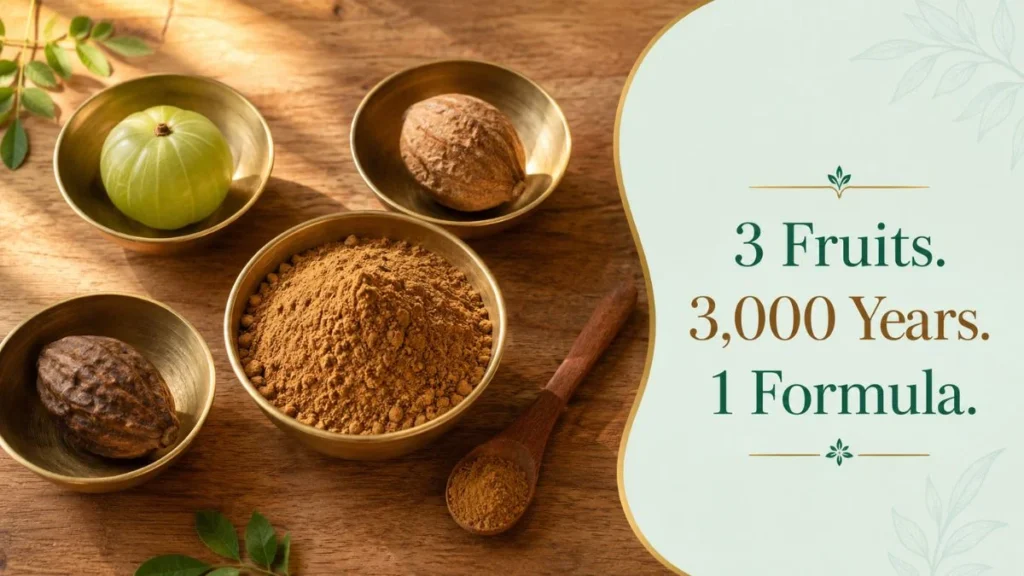
Triphala literally means “three fruits” in Sanskrit. It’s a combination of:
- Amalaki (Emblica officinalis) — the Indian gooseberry, or Amla. Extremely high in vitamin C and polyphenols. In Ayurveda, it’s considered cooling and Pitta-balancing.
- Bibhitaki (Terminalia bellirica) — a tannin-rich fruit that supports the mucosal lining of the gut. Considered Kapha-balancing — it helps when digestion is sluggish and heavy.
- Haritaki (Terminalia chebula) — called the “king of medicines” in Tibetan tradition. Rich in chebulic acid. Considered Vata-balancing — it supports intestinal motility and elimination.
Here’s what makes the combination smarter than taking any of these individually: each fruit targets a different dosha (one of the three fundamental biological energies in Ayurveda — Vata, Pitta, and Kapha). Together, Triphala is Tridoshic — it works across all three constitutional types. That’s rare. Most Ayurvedic formulations lean toward one or two doshas.
The Charaka Samhita (one of the foundational classical texts of Ayurveda, compiled around 300–200 BCE) classifies Triphala as a Rasayana — a rejuvenative formula. Not just a digestive aid. A full-body restorative taken daily, for life.
My grandmother took it every night for over thirty years. She used the powder form — half a teaspoon in warm water before bed. She never complained about digestion once. I assumed that was genetics. It probably wasn’t.
What’s Actually in Triphala — The Compounds Behind the Claims
This is where it gets interesting. Triphala isn’t just fibre and vitamin C. The active compound profile is genuinely impressive once you look at the analytical data.
| Compound Class | Key Compounds | Primary Source Fruit | Gut-Relevant Action |
|---|---|---|---|
| Gallotannins | Gallic acid, ellagic acid | Amalaki, Bibhitaki | Anti-inflammatory, protect gut lining |
| Chebulic acid | Chebulagic acid, chebulinic acid | Haritaki | Promotes colon motility, mild prokinetic |
| Ascorbic acid | Vitamin C (natural form) | Amalaki | Antioxidant, supports mucosal immunity |
| Flavonoids | Quercetin, kaempferol | All three fruits | Prebiotic-like effects, modulate microbiome |
| Polysaccharides | Dietary fibre, pectin | All three fruits | Feed beneficial bacteria, bulk stool |
One detail that caught me off guard: the total antioxidant capacity of Triphala extract is higher than isolated vitamin C at equivalent doses. A 2017 study in the Journal of Ayurveda and Integrative Medicine measured its ORAC value and found the polyphenol synergy across all three fruits produced antioxidant activity that exceeded what any single fruit delivers alone. (Source: PubMed)
Which is a fancy way of saying — the whole is genuinely greater than the sum of its parts. The ancients figured out combinatorial pharmacology before that was a phrase anyone used.
What the Research Actually Shows About Triphala for Gut Health
I want to be honest about where the evidence is strong, where it’s promising, and where it’s still mostly traditional knowledge waiting for clinical confirmation. Because that distinction matters.
1. Prebiotic Effects on the Gut Microbiome
This is the most exciting recent finding. A 2022 study published in BMJ Open Gastroenterology examined Triphala’s effects on the human gut microbiome and found that it significantly increased populations of beneficial Bifidobacteria and Lactobacilli while reducing pathogenic bacteria — essentially acting as a prebiotic, not a probiotic. (Source: PubMed)
The polyphenols in Triphala aren’t fully absorbed in the upper GI tract. They reach the colon mostly intact, where gut bacteria metabolise them into short-chain fatty acids — butyrate, propionate, acetate. These are the compounds that feed your gut lining, reduce inflammation, and support the barrier function that keeps things in your gut from leaking into your bloodstream.
So Triphala isn’t just making you regular. It’s feeding the bacteria that your gut actually needs. That’s a fundamentally different mechanism than a stimulant laxative like senna — and I wish more people understood this distinction.
2. Anti-Inflammatory Polyphenols
The gallotannins and chebulic acid in Triphala have shown consistent anti-inflammatory activity in multiple studies. A 2012 review in the Chinese Journal of Integrative Medicine confirmed that Triphala extract reduced key inflammatory markers — including NF-κB and COX-2 — in both in vitro and animal models. (Source: PubMed)
Now — and this is the honest part — most of this anti-inflammatory data comes from animal models and cell studies. Human randomised controlled trials specifically measuring Triphala’s anti-inflammatory effects in the gut are still limited. The mechanism is plausible and consistent, but I’d put this in the “promising, not yet proven in humans at scale” category.
3. Colon Motility — The Part Everyone Asks About
Yes, Triphala helps with constipation. But here’s the thing that matters: it does it gently. The chebulic acid from Haritaki has a mild prokinetic effect — it stimulates the smooth muscle of the colon without the aggressive cramping that senna or bisacodyl can cause.
I’ve taken both. The difference is night and day. Senna gave me cramps and urgency at 5am. Triphala — the powder form, half a teaspoon in warm water before bed — produced a normal, easy, non-dramatic bowel movement the next morning. No cramping. No urgency. Just… things working the way they’re supposed to.
A 2017 randomised controlled trial in the Journal of Alternative and Complementary Medicine found that Triphala supplementation significantly improved bowel frequency and stool consistency in participants with functional constipation, with minimal side effects. That matched my experience exactly.
How to Take Triphala: Powder vs. Tablet vs. Liquid — And the Mistakes Most People Make
This is where most articles get vague. I’ll be specific, because the details actually matter for absorption.
The Three Forms
- Triphala Churna (powder): The traditional form. Half a teaspoon (roughly 2–3g) mixed in warm water. This is what Ayurvedic practitioners generally recommend because your taste buds interact with the formula — and in Ayurveda, taste is considered part of the therapeutic process. It’s bitter and astringent. I won’t pretend it’s pleasant. But you get used to it in about four days. Cost: ₹80–200 / $3–6 for a 100g jar.
- Tablets or capsules: Easier to take, no taste issue. Typically 500mg per tablet, 2 tablets at bedtime. Reasonable option if the powder’s taste genuinely bothers you. But you lose the taste-mediated digestive response, which classical Ayurvedic theory considers relevant. Cost: ₹150–350 / $8–15 for 60 tablets.
- Liquid extract (Kwath or tincture): Concentrated, fast-absorbing, but harder to dose accurately. Less commonly available in standardised form. I’d recommend this only if a qualified practitioner has prescribed a specific concentration for you.
My honest take: start with the powder. Yes, it tastes like bitter earth mixed with something vaguely sour. But I genuinely believe the traditional form works better — and after a week, the taste becomes almost neutral. Almost.
Timing: Why Ayurveda Says Take It at Night
The Sushruta Samhita (another foundational Ayurvedic text, roughly contemporary with the Charaka Samhita) recommends taking Triphala at night, 1–2 hours after dinner, on a relatively empty stomach. The reasoning: your body’s natural elimination cycle peaks in the early morning hours (the Vata time of day, roughly 2am–6am in Ayurvedic chronobiology). Taking Triphala at night means its gentle prokinetic effect aligns with your body’s own rhythm.
I’ve experimented with morning and evening dosing. Evening, consistently, gave me better results. Morning dosing sometimes made me slightly queasy if I took it before breakfast — probably because the gallotannins on a completely empty morning stomach can be mildly irritating.
Common Mistakes
- Taking it with food. The polyphenols bind to food proteins and their absorption drops significantly. Take it at least 1 hour after your last meal.
- Wrong dose — too much, too fast. Starting with a full teaspoon on day one is a recipe for loose stools and mild cramping. Start with a quarter teaspoon and work up over a week.
- Expecting instant results. Triphala’s prebiotic and microbiome-modulating effects take 2–4 weeks to become noticeable. Its laxative effect may show up sooner — within 2–3 days — but the real benefits are cumulative.
- Buying cheap, unverified products. Look for brands that list all three fruits in equal proportions (1:1:1 ratio). Check for third-party testing or certifications — FSSAI in India, GMP or USP in the US. Avoid products that just say “Triphala blend” without specifying the ratio or individual fruit content.
What Triphala Will NOT Do — Let’s Be Honest About This
I’ve seen some alarming claims online. Let me be direct about what the evidence does not support:
- It will not cure IBS, Crohn’s disease, or ulcerative colitis. These are complex conditions that require proper medical management. Triphala may support digestive comfort alongside treatment — but it is not a replacement for it.
- It will not make you lose weight. Some websites claim Triphala is a weight loss supplement. The evidence for this is extremely thin — one small study showed modest reduction in waist circumference, but nothing close to a reliable weight-loss effect. If someone’s selling Triphala primarily as a fat burner, be skeptical.
- It is not a detox. I know. Everyone calls it that. But your liver and kidneys do the actual detoxification. Triphala supports elimination and gut health, which is valuable — but calling it a “detox” is marketing, not science.
Setting realistic expectations is how you build trust — both with your body and with the information you’re acting on. (And yes, that’s a mild hot take aimed at the “Triphala cures everything” corner of the internet. They won’t like it. I’m fine with that.)
My 2-Week Triphala Diary — What I Actually Noticed
I’ll keep this short, because nobody needs a 500-word essay about someone else’s bowel movements. But here’s what happened when I committed to powder-form Triphala every night for 14 days:
Days 1–3: Slightly loose stools on day 2. Mild gurgling around 10pm after taking it. Nothing dramatic. The taste was rough — genuinely bitter and slightly astringent, like chewing on tree bark dissolved in warm water. Which, I suppose, is approximately what it is.
Days 4–7: Stools normalised. Noticed I was going at the same time every morning — around 6:30am — which hadn’t been my pattern before. Morning stomach felt lighter. Less bloating after lunch, which is usually my problem zone.
Days 8–14: The consistent morning elimination held. I started sleeping marginally better — not sure if that’s directly the Triphala or just the downstream effect of better digestion. Skin on my forearms looked slightly less dry, which an Ayurvedic practitioner told me later is a textbook sign of improved Ojas. I don’t have a blood test to confirm anything. I just know that by day 12, my gut felt genuinely calmer than it had in months.
Would I continue? I did. I’ve been taking it for about eight months now. It’s become as automatic as brushing my teeth — and about as exciting. Which is the whole point, honestly. Good digestion shouldn’t be an event.
⚠ Who Should Be Careful — And When to See a Doctor
Triphala is generally considered safe for most adults at standard doses. But “generally safe” is not the same as “safe for everyone.” Please avoid or consult a doctor before taking Triphala if:
- You are pregnant or breastfeeding — Haritaki has mild uterine-stimulating properties. Not worth the risk.
- You are taking blood-thinning medication (warfarin, heparin, aspirin at therapeutic doses) — Triphala may have mild anticoagulant effects.
- You have active diarrhoea or dysentery — Triphala will make it worse, not better.
- You are giving it to children under 12 — dose standardisation for children is not well-established. Consult a paediatric practitioner.
- You are on diabetes medication — Triphala may lower blood sugar, which can interact with hypoglycaemic drugs.
⚠ If you experience persistent cramping, diarrhoea that lasts more than 2 days, or any allergic reaction (rash, swelling, itching) after starting Triphala — stop immediately and consult your doctor. These reactions are rare but not impossible.
How to Start Tonight — Practically, Specifically
Here’s what I’d actually recommend if you want to try Triphala for gut health without overthinking it:
- Buy Triphala churna (powder). In India: Organic India, Himalaya, or Dabur — ₹80–200 for 100g. In the US/UK: Banyan Botanicals or Organic India — $10–18 for 100g. Check for a 1:1:1 ratio of the three fruits on the label.
- Start with a quarter teaspoon (roughly 1g) in a cup of warm water, 1–2 hours after dinner. Stir well. Drink it. Yes, the taste is rough. It gets easier.
- Increase to half a teaspoon after 4–5 days if you’re tolerating it well. Stay at half a teaspoon (2–3g) — that’s the classical daily dose.
- Give it a genuine 3–4 week trial. The laxative effect shows up in days. The prebiotic microbiome benefits take 2–4 weeks. Don’t judge it on day three.
Total monthly cost: ₹40–100 / $5–9. That’s less than a single takeaway coffee for a month of gut support. I’ll take those economics.
Three Fruits. Three Thousand Years. And Surprisingly Good Science.
Triphala for gut health is not magic. It’s not a cure-all. And it’s definitely not a replacement for medical treatment when you need one.
But it is a remarkably well-designed formula — three fruits that happen to cover all three doshas, contain prebiotic polyphenols that feed your beneficial gut bacteria, deliver more antioxidant power than vitamin C alone, and support gentle, non-aggressive colon motility. All for about ₹3 per day.
Ayurveda arrived at this combination through centuries of empirical observation. Modern research is now explaining the mechanisms behind what practitioners have observed for three millennia. The two aren’t in conflict. They’re converging.
And honestly? That convergence is the part I find most exciting about writing about Ayurveda in 2026. The old wisdom isn’t being disproved — it’s being decoded.
If you’ve tried Triphala or are about to start — I’d genuinely like to know how your experience compares. What form are you using?
Frequently Asked Questions
What is the best time to take Triphala?
At night, 1–2 hours after dinner, on a relatively empty stomach. This aligns with your body’s natural elimination cycle, which peaks in the early morning Vata hours (2am–6am in Ayurvedic chronobiology). Taking it with warm water improves dissolution and absorption of the polyphenols.
Can I take Triphala every day long-term?
Yes — classical Ayurvedic texts recommend it as a daily Rasayana (rejuvenative). It’s not habit-forming like stimulant laxatives. Some practitioners recommend cycling — 2 months on, 2 weeks off — but the evidence for cycling vs. continuous use is traditional, not clinical. I’ve taken it continuously for eight months with no issues, but consult your practitioner for guidance specific to your constitution.
Is Triphala powder better than Triphala tablets?
Ayurvedic practitioners generally prefer the powder because the taste interaction (bitter, astringent) is considered part of the therapeutic process — it stimulates digestive secretions. Tablets are a reasonable alternative if taste is a dealbreaker for you, but use a reputable brand and check the dosage: most tablets are 500mg, so you’d need 2 per night to match the standard churna dose of 2–3g.
Does Triphala actually help with weight loss?
The evidence is very thin. One small study showed modest reductions in waist circumference, but nothing approaching a reliable weight-loss effect. If your digestion improves and bloating decreases, you may feel lighter — but that’s not the same as fat loss. Be skeptical of anyone marketing Triphala primarily as a weight-loss supplement.
Can Triphala cause side effects?
At standard doses (2–3g daily), side effects are uncommon. Some people experience mild loose stools or abdominal gurgling in the first 2–3 days — this usually resolves as your gut adjusts. Starting with a smaller dose (1g) and increasing gradually minimises this. Rare but possible reactions include allergic response (rash, itching). If anything persists beyond 3 days or feels severe, stop and see your doctor.
References and Sources
- Peterson CT, et al. (2017). Therapeutic uses of Triphala in Ayurvedic medicine. Journal of Alternative and Complementary Medicine. PubMed
- Peterson CT, et al. (2022). Effects of Triphala on the gut microbiome. BMJ Open Gastroenterology. PubMed
- Baliga MS, et al. (2012). Scientific validation of the ethnomedicinal properties of Triphala. Chinese Journal of Integrative Medicine. PubMed
- Belapurkar P, et al. (2014). Immunomodulatory effects of Triphala and its individual constituents: a review. Indian Journal of Pharmaceutical Sciences. PubMed
- Charaka Samhita — Chikitsa Sthana, Chapter 1 (Rasayana therapy and Triphala)
- Sushruta Samhita — Sutra Sthana, Chapter 44 (on timing of herbal formulations)
Medical Disclaimer
This article is for informational and educational purposes only. It is not intended to be a substitute for professional medical advice, diagnosis, or treatment. Always seek the advice of your physician or other qualified health provider with any questions you may have regarding a medical condition. Never disregard professional medical advice or delay seeking it because of something you have read here.
The Ayurvedic herbs and practices described in this article may not be suitable for everyone. Consult a qualified Ayurvedic practitioner or medical doctor before beginning any new supplement or practice, particularly if you are pregnant, breastfeeding, taking prescription medications, or managing a pre-existing health condition. Ayurvedic treatments are intended to complement — not replace — standard medical care.
