


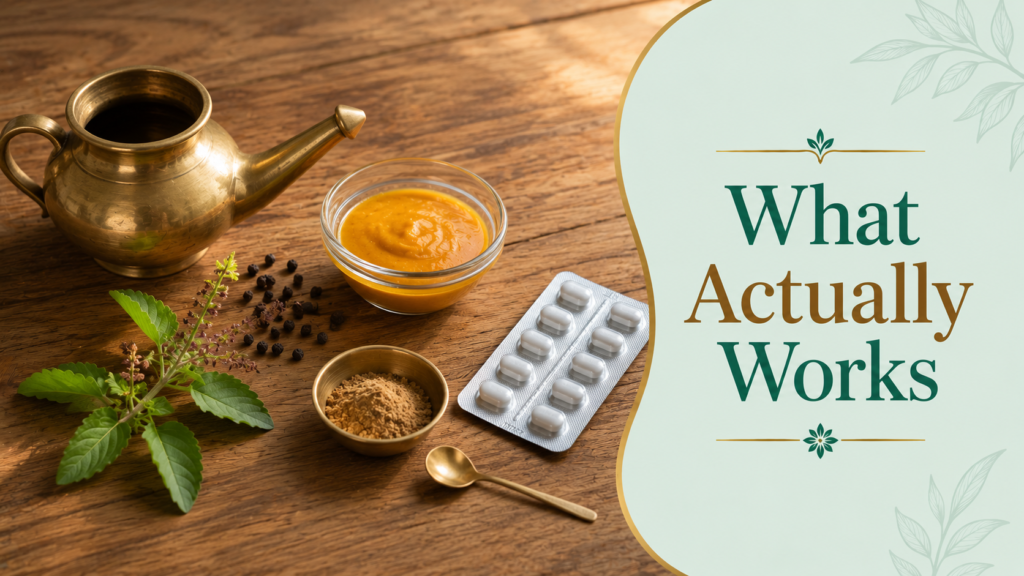
Seasonal Allergies and Ayurveda for Allergies: What Works, What Doesn’t, and What I Wish I Knew Sooner
By a health and Ayurveda writer with 10+ years of practice | Updated June 2026 | 8 min read
Every March, like clockwork, my nose declares war on me.
The sneezing starts around Holi. By mid-March, I’m going through a box of tissues a day. My eyes water during meetings.
My throat has that specific raw itch that makes swallowing feel like sandpaper. And every single year, I think: this is the year Ayurveda for allergies will finally sort this out completely.
I’ve been practising Ayurveda for over a decade. I’ve tried Nasya, Trikatu, turmeric in every conceivable form, Neti pots, Tulsi tea by the litre, and at least three formulations my grandmother swore would “clear the Kapha.”
Some of it helped — genuinely, measurably helped. Some of it did absolutely nothing. And some of it I clung to out of stubbornness long after the evidence (and my sinuses) told me to stop.
So here’s the honest version. Not the Instagram-Ayurveda version where every ancient remedy works perfectly. The real version — what actually helped my seasonal allergies, what flopped, and the one thing I wish someone had told me years ago.
What Ayurveda for Allergies Actually Says About Seasonal Flare-ups
Ayurveda doesn’t use the word “allergy.” But it has been describing exactly what we now call allergic rhinitis for roughly three thousand years — under the term Pratishyaya (literally “flowing against” — referring to nasal discharge and congestion caused by aggravated doshas).
The framework is built on two core ideas:
1. Ritucharya (seasonal regimen). The Charaka Samhita (one of the foundational classical texts of Ayurveda, compiled around 300–200 BCE) divides the year into six seasons, each with specific dietary and lifestyle prescriptions. Spring — Vasanta Ritu — is classified as Kapha season.
The warming temperatures liquefy the Kapha dosha (the biological energy governing structure, moisture, and mucus) that accumulated during winter. This liquefied Kapha overwhelms the respiratory system. That’s your runny nose, your congestion, your heavy-headed brain fog.
I’ll be honest — when I first read this framing, I thought it was poetic metaphor. Then I lived through enough March-to-May allergy seasons to notice the pattern was exactly as described. The timing was too precise to dismiss.
2. Ama (metabolic toxins). Ayurveda argues that weak digestion — Mandagni (low digestive fire) — produces a sticky metabolic residue called Ama that clogs channels and weakens immunity.
When spring arrives and Kapha melts, it mixes with accumulated Ama and the result is allergic symptoms. The prescription? Strengthen digestion, reduce Ama, and pacify Kapha — ideally before allergy season starts.
Modern immunology describes the same phenomenon differently: histamine release triggered by an overactive immune response to harmless environmental proteins (pollen, dust, mould). The language is different.
The seasonal timing is identical. Ayurveda identified seasonal allergies as a Kapha problem 3,000 years before anyone had a word for histamine.
Ayurveda for Allergies: What I Found Actually Works
I’ve tried most of the commonly recommended Ayurvedic seasonal allergy treatments over three consecutive allergy seasons — 2023, 2024, and 2025. I tracked my symptoms informally (sneezing frequency, sleep quality, days I reached for an antihistamine).
This isn’t a clinical trial. It’s one person’s honest record.
| Remedy | What It Is | My Experience | Evidence Level |
|---|---|---|---|
| Neti pot (saline nasal irrigation) | Warm saline flushed through nasal passages using a small pot — Jala Neti in yogic tradition | Genuinely effective. Reduced my morning sneezing by about 60%. The single most useful daily practice. | Strong — multiple RCTs, recommended by NHS and ENT guidelines |
| Nasya (nasal oil therapy) | 2–3 drops of medicated oil (typically Anu Taila) applied to each nostril daily | Noticeably helpful. Reduced nasal dryness and irritation. Best when done after Neti. | Moderate — traditional evidence strong; limited modern RCTs, some pilot studies positive |
| Turmeric + black pepper | Curcumin (from Haridra, turmeric) with piperine for absorption — as golden milk or capsule | Mild but real benefit. Inflammation felt lower over weeks. Not a quick fix. | Moderate — a 2016 Annals of Allergy study showed curcumin reduced nasal symptoms in allergic rhinitis |
| Trikatu | Classical Ayurvedic blend of black pepper, long pepper (Pippali), and ginger — traditionally used to clear Kapha | Helpful for congestion. Cleared heavy morning stuffiness within 20 minutes. Harsh on an empty stomach. | Traditional — strong classical basis; limited modern clinical data specifically for allergies |
| Tulsi tea | Holy basil (Tulsi, Ocimum tenuiflorum) steeped as tea, 2–3 cups daily | Pleasant. Mildly soothing. No dramatic allergy relief on its own. | Preliminary — anti-inflammatory properties documented; no strong allergy-specific RCTs |
The Neti pot was the clear winner. I resisted it for an embarrassingly long time because the idea of pouring warm salt water through my nose sounded unpleasant. It is slightly unpleasant — for about four days.
After that, it becomes routine. A 2012 Cochrane review found that saline nasal irrigation significantly improved symptoms and quality of life in adults with allergic rhinitis. (Source: PubMed)
The NHS recommends it. Multiple ENT specialists recommend it. And Ayurveda has been prescribing Jala Neti for centuries.
Nasya — applying Anu Taila (a classical medicated sesame oil) to the nostrils after Neti — added a layer of protection that I hadn’t expected. It coats the nasal passages, which may reduce direct pollen contact with the mucous membrane. I buy Anu Taila from Kottakkal Arya Vaidya Sala — a 10ml bottle costs about ₹120–180 ($1.50–2.25) and lasts three to four weeks.
The turmeric and black pepper combination worked — but slowly. I take a standardised curcumin supplement (500mg with piperine) daily during allergy months.
A 2016 randomised controlled trial published in Annals of Allergy, Asthma and Immunology found that curcumin significantly reduced nasal symptoms and improved nasal airflow in patients with allergic rhinitis over 8 weeks. (Source: PubMed)
But this isn’t a rescue remedy. It’s a slow, cumulative anti-inflammatory effect. If you’re expecting it to work like cetirizine in 30 minutes, you’ll be disappointed.
The Honest Part: What Didn’t Work (or Barely Did)
This is the section most Ayurveda blogs won’t write. I’m writing it because I wish someone had saved me two seasons of stubbornness.
- Tulsi tea as a standalone allergy remedy: I love Tulsi. I drink it year-round. But as a specific treatment for acute allergy symptoms? It didn’t move the needle for me. It’s soothing, yes. Anti-inflammatory in a general sense, sure. But my sneezing count on Tulsi-tea-only days was identical to days I didn’t drink it. I think it’s excellent for general immunity and a lovely daily habit — just not a targeted allergy intervention.
- Sitopaladi Churna for seasonal allergies: This classical formulation (sugar, bamboo manna, cardamom, cinnamon, Pippali) is widely recommended online for respiratory issues, but when I tried it for six weeks during peak season, I noticed only mild throat soothing. There was no meaningful change in my nasal symptoms. The evidence base for allergies specifically is thin.
- Steam inhalation with eucalyptus alone: Felt nice for about ten minutes, but the congestion returned within the hour. While not entirely useless, it is wildly oversold as a remedy. It remains a source of comfort, not a treatment.
- Avoiding all cold foods as a complete strategy: Ayurvedic dietary advice for Kapha season — eat warm, avoid cold, skip dairy, reduce sweets — is genuinely sound and I noticed mild improvement when I followed it. But diet changes alone, without any of the other interventions, weren’t enough to manage real allergy symptoms. They’re a supporting act, not the headliner.
Look — I spent two full allergy seasons refusing antihistamines on principle, convinced that Ayurveda alone should handle it. My sinuses did not care about my principles. More on that in a moment.
When to Just Take the Antihistamine — Without Guilt
This is the thing I wish someone had told me sooner: Ayurveda and modern allergy medicine are not opposing teams. They address different layers of the same problem.
Antihistamines (cetirizine, fexofenadine, loratadine) block histamine receptors. They work within 30–60 minutes. They’re well-studied, widely available, and cost ₹2–5 per tablet.
For acute allergy attacks — the kind where you’re sneezing twelve times in a row and your eyes are streaming — they are simply more effective than any herbal intervention I’ve tried.
That’s not a failure of Ayurveda. That’s a recognition that acute symptom management and long-term constitutional rebalancing are different medical goals.
The combination I’ve settled into after three years of experimentation:
- Daily foundation (Ayurvedic): Morning Neti pot + Nasya with Anu Taila. Turmeric-piperine capsule with breakfast. Trikatu powder (a quarter teaspoon in warm water) if I wake up congested.
- Dietary support (Ayurvedic): Warm cooked meals. Reduced dairy during peak weeks. Ginger and black pepper in most meals. Light dinner before 8pm.
- When symptoms break through (modern medicine): One cetirizine tablet. No guilt. No philosophical crisis. It works in 40 minutes and lets me function.
My allergy days per season dropped from roughly 45 to about 12 since I adopted this combined approach. The Ayurvedic practices reduced the baseline inflammation.
The antihistamine handles the spikes. Together, they work better than either one alone.
Foods That Make Seasonal Allergies Worse — The Kapha Connection
This is where Ayurvedic dietary guidance gets genuinely practical. During Kapha season (roughly February through May in most of India, and September through November in some regions), certain foods increase Kapha accumulation and may worsen allergy symptoms:
- Cold dairy — ice cream, cold milk, yoghurt (especially at night). Warm milk with turmeric is fine; a bowl of cold curd at 10pm is asking for morning congestion.
- Refined sugar and sweets — increase Ama and suppress Agni (digestive fire)
- Heavy, oily fried foods — samosas, pakoras, anything deep-fried in the evening
- Cold beverages — chilled water, cold juices, iced coffee
- Bananas and watermelon at night — both increase Kapha according to classical texts
What helps instead: warm soups, ginger tea, light grain-based meals, steamed vegetables, moong dal, honey (which Ayurveda considers Kapha-reducing — a teaspoon in warm water, not hot, since heating honey above 40°C is contraindicated in Ayurvedic texts). Spices like black pepper, cinnamon, and dry ginger in cooking act as natural Kapha-pacifying agents.
I’m not going to pretend I follow this perfectly. During my last allergy season, I ate ice cream twice in the same week because sometimes you just want ice cream. My nose punished me both times.
Live and learn. And then learn again because apparently I didn’t learn the first time.
⚠ When Your “Allergy” Might Be Something Else — See a Doctor If:
Seasonal allergies are annoying but manageable. Some things that look like allergies are not — and they need proper medical assessment:
- Your symptoms last year-round with no seasonal pattern — this may indicate a chronic sinus condition, dust mite allergy, or nasal polyps
- You’re wheezing or having difficulty breathing — allergic asthma needs proper diagnosis and management
- You have thick, discoloured nasal discharge (green or yellow) with facial pain — possible sinus infection, not just allergies
- Antihistamines have stopped working after long-term use — you may need a different class of medication or allergy testing
- Your symptoms are getting worse each year despite management — consider seeing an allergist for immunotherapy options
- You’re experiencing skin rashes, hives, or food-related allergic reactions — different mechanism, needs different treatment
Allergies are extremely common and very treatable. An ENT or allergist can run specific IgE tests, identify your exact triggers, and recommend targeted treatment.
Self-management with Ayurveda and OTC antihistamines works for most people. But if it’s not working, please get properly assessed.
⚠ Contraindications: Trikatu should be avoided if you have active gastritis, acid reflux (GERD), or peptic ulcers — it’s warming and pungent. Nasya should not be performed during acute sinus infections, after meals, or during pregnancy without practitioner guidance.
Curcumin supplements may interact with blood thinners (warfarin) and diabetes medications. Always consult your doctor before adding any supplement to your routine.
How to Start This Week — A Simple Daily Routine
Don’t try everything at once. I made that mistake. Pick the layer that matches your current allergy severity:
- Today: Buy a Neti pot. Brass or ceramic, available at any Ayurveda shop or on Amazon — ₹150–350 ($2–4.50). Use warm water with half a teaspoon of non-iodised salt. Do it once, morning. It feels odd for three days, then becomes unremarkable.
- This week: Add Nasya after your morning Neti. Anu Taila from Kottakkal or Arya Vaidya Pharmacy — ₹120–180 ($1.50–2.25) for 10ml. Two drops per nostril, lie back for a minute. The whole routine takes under 5 minutes.
- For the season: Start a daily curcumin supplement with piperine (500mg with food), giving it 4–6 weeks to show effect. Reliable brands like Cureveda or Organic India work well. The cost runs around ₹400–800 ($5–10) per month.
- When symptoms spike: Take an over-the-counter antihistamine like cetirizine or fexofenadine (₹2–5 per tablet). There is no need for guilt or an ideological crisis. Simply use it to function, while maintaining your daily Ayurvedic foundation.
Ancient Wisdom, Modern Honesty — Both Belong in Your Medicine Cabinet
Ayurveda for allergies works — but not in the way wellness Instagram suggests. It is not a magic replacement for modern medicine, but a foundation.
It helps reduce baseline inflammation, support your body’s natural defences, and decrease how often you need acute intervention.
My allergy seasons have gotten genuinely better since I stopped treating Ayurveda and conventional medicine as rival philosophies. I now treat them as complementary layers.
This means Neti and Nasya every morning, turmeric in my system, and warm, Kapha-light food. Plus, a cetirizine tablet in my pocket when pollen doesn’t care about my routine.
The Charaka Samhita was right about Kapha season, and modern pharmacology is right about histamine. When using Ayurveda for allergies, you don’t have to choose one over the other. Both can work together.
What’s working for your allergy season? I’m genuinely curious — especially if you’ve found something I missed.
Frequently Asked Questions
Can Ayurveda cure seasonal allergies permanently?
Honestly? Probably not in the permanent-elimination sense. Allergies involve immune system sensitisation that rarely reverses fully in adults.
But Ayurvedic practices — particularly Ritucharya, daily Neti, Nasya, and dietary adjustments — can significantly reduce symptom severity. I’ve gone from 45+ bad days per season to about 12.
The classical texts frame this as restoring balance rather than eliminating disease. I think that’s an honest way to set expectations.
Is Trikatu safe to take daily during allergy season?
For most people without gastric sensitivity, yes, in small doses (a quarter to half teaspoon with warm water or honey, after meals). But Trikatu is strongly warming and pungent.
If you have acid reflux, gastritis, or a Pitta-dominant constitution, it can aggravate those conditions significantly. I take it only on congested mornings for this reason.
Start with a small dose and pay attention to how your digestion responds. Consult an Ayurvedic practitioner if you are unsure.
How is a Neti pot different from a nasal spray?
A Neti pot (Jala Neti) uses gravity to flow a larger volume of warm saline through your nasal passages. It flushes out mucus, pollen, and dust physically.
Nasal sprays deliver a fine mist in smaller volumes. Both work, but the Neti pot provides a more thorough mechanical rinse.
The key is using properly dissolved non-iodised salt in distilled or boiled-and-cooled water. Never use tap water directly.
Can I use Ayurvedic remedies alongside antihistamines?
Yes, and that’s precisely what I recommend based on my own experience. Neti, Nasya, and dietary changes operate on different mechanisms than antihistamines.
There are no known interactions between saline nasal irrigation or Anu Taila and standard OTC antihistamines. The curcumin-piperine combination is worth mentioning to your doctor, especially if you are taking blood thinners.
For most people, the combination of Ayurvedic daily practices and occasional antihistamine use works better than either approach alone.
References and Sources
- King D, et al. (2012). Saline nasal irrigation for acute upper respiratory tract infections. Cochrane Database of Systematic Reviews. PubMed
- Wu S, Xiao D. (2016). Effect of curcumin on nasal symptoms and airflow in patients with perennial allergic rhinitis. Annals of Allergy, Asthma and Immunology. PubMed
- Charaka Samhita — Sutra Sthana, Chapter 6 (on Ritucharya — seasonal regimen)
- Charaka Samhita — Chikitsa Sthana, Chapter 26 (on Pratishyaya — nasal disorders)
- NHS (2024). Allergic rhinitis — Treatment. NHS.uk
Medical Disclaimer
This article is for informational and educational purposes only. It is not intended to be a substitute for professional medical advice, diagnosis, or treatment. Always seek the advice of your physician or other qualified health provider with any questions you may have regarding a medical condition.
Never disregard professional medical advice or delay seeking it because of something you have read here.
The Ayurvedic herbs and practices described in this article may not be suitable for everyone. Consult a qualified Ayurvedic practitioner or medical doctor before beginning any new supplement or practice, particularly if you are pregnant, breastfeeding, taking prescription medications, or managing a pre-existing health condition. Ayurvedic treatments are intended to complement — not replace — standard medical care.
If you or someone you know is in mental health distress, please contact a qualified professional or one of the helplines listed above.
