


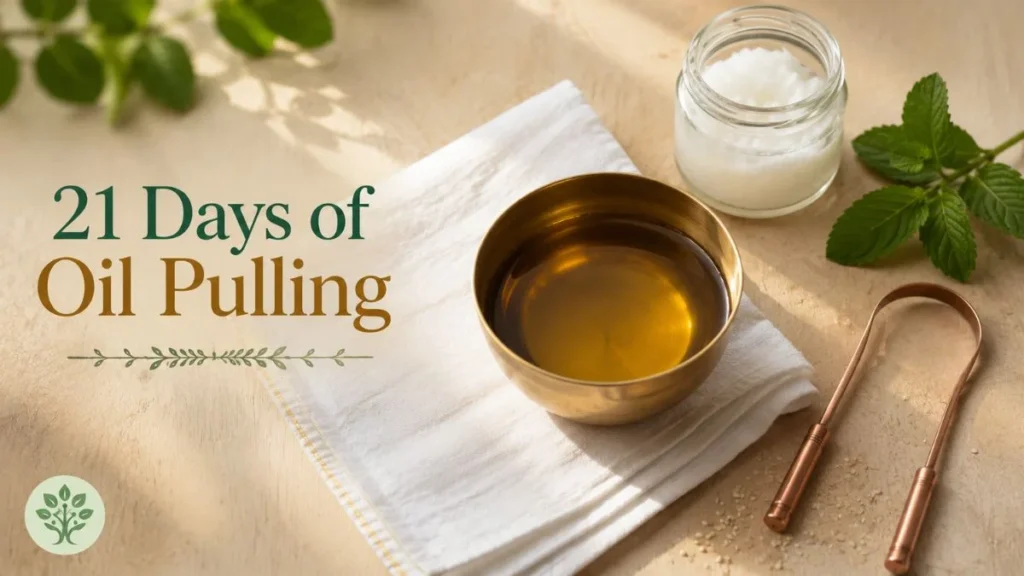
What Happens to Your Body When You Do Oil Pulling Every Day — The Science Behind Oil Pulling Benefits (I Did It for 21 Days)
By a health and Ayurveda writer with 10+ years of practice | Updated June 2026 | 11 min read
I swished sesame oil in my mouth for twenty minutes every morning for twenty-one consecutive days. On purpose.
If that sentence made you wince, good. That was roughly my reaction when I first read about oil pulling benefits in a dog-eared copy of the Charaka Samhita (one of the foundational classical texts of Ayurveda, compiled around 300–200 BCE) about eight years ago.
But here’s the thing — I kept seeing it pop up. Instagram wellness accounts swearing it whitened their teeth. A dentist friend in Bangalore who mentioned it casually over coffee.
And then a 2009 study in the Indian Journal of Dental Research that made me stop scrolling and actually read.
So I decided to do what I always do when I can’t tell if something is ancient wisdom or ancient nonsense. I tried it myself, tracked everything, and read every clinical study I could find. This is the full, honest result.
What Oil Pulling Actually Is — And Where It Comes From
Oil pulling is exactly what it sounds like. You put a tablespoon of oil in your mouth, swish it around for 15–20 minutes, and spit it out.
That’s it. No swallowing, no gargling, no special equipment.
The practice comes from Ayurveda, where it appears under two names: Kavala Graha (filling the mouth with oil and swishing) and Gandusha (holding oil in the mouth without swishing). The Charaka Samhita describes it as part of Dinacharya (daily routine) and recommends it for strengthening the jaw, improving voice, and preventing oral diseases.
For roughly 2,500 years, it stayed within Indian traditional practice. Then sometime around 2008–2010, it went viral in Western wellness circles — driven largely by social media, a few celebrity endorsements, and the eternal human hope that one weird trick might fix everything.
The claims got wild. Oil pulling will detox your liver. Oil pulling will cure your migraines.
Oil pulling will clear your skin, fix your sinuses, reverse diabetes. I’ve seen all of these stated as fact on wellness blogs. None of them are supported by any published research.
But the original Ayurvedic claims? The ones about oral health specifically? Those are more interesting — and some of them have genuine clinical evidence behind them.
Oil Pulling Science: What the Research Actually Shows
I’m going to walk through the key studies one by one, because the details matter. Most wellness articles cite “studies show” without telling you what the studies actually measured, how many people were involved, or what the limitations were.
Study 1: Sesame Oil vs. Chlorhexidine for Streptococcus mutans
A 2009 study by Asokan et al. published in the Indian Journal of Dental Research compared oil pulling with sesame oil to chlorhexidine mouthwash (the clinical gold standard for antibacterial oral rinses) in 20 adolescents over a 10-day period. (PubMed)
The result: sesame oil pulling significantly reduced Streptococcus mutans counts in plaque and saliva, comparable to chlorhexidine. S. mutans is the primary bacterium responsible for dental cavities.
That’s a genuinely interesting finding. But — and this matters — the study had only 20 participants and lasted 10 days. It’s a pilot study, not definitive proof.
Study 2: Oil Pulling and Plaque-Induced Gingivitis
A 2015 randomised controlled trial by Peedikayil et al. in the Journal of Clinical and Diagnostic Research studied coconut oil pulling in 60 participants aged 16–18 with plaque-induced gingivitis over 30 days. (PubMed)
Both plaque index and gingival index scores decreased significantly from Day 7 onwards. The researchers concluded that coconut oil pulling could be used as an effective adjuvant to conventional oral hygiene.
This is a stronger study — larger sample, longer duration, randomised design. Still relatively small by medical research standards, but meaningful.
Study 3: Sesame Oil Pulling and Halitosis
Asokan et al. (2011) also tested oil pulling against halitosis (bad breath) in 20 adolescents and found it equally effective as chlorhexidine in reducing organoleptic breath scores and the microorganisms associated with halitosis. (PubMed)
Again — small sample, but consistent results across multiple measurements.
Study 4: Systematic Review (2020)
A 2020 systematic review by Woolley et al. in Heliyon analysed multiple oil pulling studies and concluded that oil pulling may reduce bacterial count, plaque formation, and risk of gingivitis but called for larger, better-designed trials. (PubMed)
That’s the honest summary. The evidence is promising for oral health specifically. It is not strong enough to make definitive clinical recommendations.
And it says absolutely nothing about systemic detoxification, organ cleansing, or any of the grander claims.
What Oil Pulling Does NOT Do — Detox Myths Debunked
This is the part that will lose me followers, and I’m writing it anyway.
Oil pulling does not detox your body. There is no mechanism by which swishing oil in your mouth draws toxins from your bloodstream, liver, kidneys, or any internal organ. Your liver and kidneys handle detoxification.
They’re quite good at it. Oil in your mouth has no biochemical pathway to influence that process.
Oil pulling does not whiten teeth in the bleaching sense. If your teeth appear slightly brighter after oil pulling, it’s likely because you’ve reduced surface plaque — the same thing brushing well achieves. It’s not a whitening treatment.
Oil pulling does not cure systemic diseases. I’ve read claims about diabetes reversal, headache cures, asthma relief, and skin clearing. None of these have any published clinical support.
Not a single randomised trial. Not even a credible case study.
What oil pulling appears to do — based on the available evidence — is reduce oral bacteria, plaque, and gingival inflammation through a mechanical process (the swishing action physically dislodges bacteria) combined with the antibacterial properties of certain oils (sesame oil contains sesamin and sesamolin; coconut oil contains lauric acid).
That’s not a miracle. It’s oral hygiene.
And honestly? Effective oral hygiene is worth a lot more than a fake miracle.
My 21-Day Oil Pulling Experiment — The Full Diary
I used cold-pressed sesame oil (Tila Taila — the oil traditionally recommended in the Charaka Samhita) rather than coconut oil. One tablespoon, first thing in the morning, before drinking water or brushing. I set a timer for 20 minutes each session.
I continued my normal oral hygiene — brushing twice daily with fluoride toothpaste, flossing every evening. The oil pulling was an addition, not a replacement.
Week 1 (Days 1–7): The Learning Curve
Day 1: The sesame oil tasted nutty and not terrible. Holding a tablespoon of liquid in my mouth for 20 minutes, though? Exhausting.
My jaw ached by minute 12. I spat it out at minute 15.
Day 2: Nearly gagged when I tilted my head back accidentally and the oil hit the back of my throat. Lesson learned — keep your chin slightly down, gentle swishing only.
Day 3: Started doing it while showering. This was the game-changing insight — the 20 minutes suddenly felt manageable when I wasn’t just sitting there staring at the wall.
Days 4–7: The jaw soreness faded. I got the technique down — gentle, rhythmic pulling through the teeth, not aggressive swishing.
The oil turns thin and milky-white by minute 15. That’s emulsification with saliva, not “toxins being pulled out” despite what some blogs claim.
Week 2 (Days 8–14): The First Changes
Day 8: My mouth felt noticeably cleaner after spitting. Not “wow, everything is different” clean. More like “I just came back from a dental hygienist” clean.
A subtle but real freshness that lasted into the afternoon.
Day 10: I noticed my gums looked slightly less red around the lower front teeth — the area where I always get the most plaque buildup. Could be confirmation bias. Noted it and moved on.
Day 14: This was the first objectively measurable change. My gums did not bleed when I flossed. This matters because my lower front gums had bled during flossing roughly 3–4 times per week for years.
Two straight weeks of oil pulling and the bleeding stopped. I checked my flossing technique — same as always. The variable that changed was the oil pulling.
Week 3 (Days 15–21): The Honest Assessment
Days 15–18: Gums still not bleeding. Breath remained noticeably fresher in the mornings. My teeth did not look whiter.
My skin did not clear up. I did not feel “detoxed.” I felt like a person with cleaner gums and fresher breath.
Day 19: I tried coconut oil for one day out of curiosity. I found it harder to work with — it’s solid at room temperature (anything below ~24°C), so I had to let it melt in my mouth first. The sesame oil was easier and, based on Ayurvedic tradition, more authentic.
Day 21: Final assessment. The changes I can honestly attribute to oil pulling: reduced gum bleeding (significant), fresher breath (noticeable), and a general “cleaner mouth” sensation (subjective but consistent).
Changes I cannot attribute to oil pulling: zero. Nothing systemic happened. My energy levels, skin, digestion, and sleep were identical to before.
Oil Pulling Benefits: Traditional Claims vs. What Research Supports
| Claim | Traditional Source | Modern Evidence | Verdict |
|---|---|---|---|
| Reduces cavity-causing bacteria | Charaka Samhita (oral disease prevention) | Supported — Asokan 2009, comparable to chlorhexidine | Supported |
| Reduces plaque and gingivitis | Charaka Samhita (gum strengthening) | Supported — Peedikayil 2015, significant reduction in 30 days | Supported |
| Reduces bad breath | Charaka Samhita (voice and mouth freshness) | Supported — Asokan 2011, equal to chlorhexidine | Supported |
| Strengthens jaw and gums | Charaka Samhita (jaw strengthening) | Plausible — 20 min of jaw exercise is mild physiotherapy | Plausible but unproven |
| Whitens teeth | Modern wellness claim (not Ayurvedic) | No evidence — plaque removal may slightly brighten, but no bleaching effect | Not supported |
| Detoxifies the body | Modern wellness claim (not Ayurvedic) | No evidence — no mechanism, no studies | Not supported |
| Cures systemic diseases (diabetes, asthma, migraines) | Modern wellness claim (not Ayurvedic) | No evidence — not a single RCT | Not supported |
Notice something? The claims that are actually supported by research are the original Ayurvedic ones — the modest, oral-health-specific claims from the Charaka Samhita.
The wild, inflated claims? Those all came from modern Western wellness culture, not from Ayurveda itself.
I find that genuinely ironic. The ancient text was more scientifically honest than the Instagram posts.
The Practical Guide: How to Do Oil Pulling Correctly
Which Oil — Sesame or Coconut?
Sesame oil (Tila Taila) is the traditionally recommended oil in the Charaka Samhita and the one used in the majority of clinical studies. It contains sesamin and sesamolin — compounds with documented antibacterial and anti-inflammatory properties.
Coconut oil is the more popular choice in Western wellness circles, largely because it tastes milder. It contains lauric acid, which has antimicrobial properties. The Peedikayil 2015 study used coconut oil and showed positive results.
My preference after 21 days: sesame. It’s more authentic to the practice, better studied, and I actually grew to like the nutty flavour. But either works — use what you’ll stick with.
The Technique
- When: First thing in the morning, before eating, drinking, or brushing teeth. Empty stomach.
- Amount: One tablespoon. Not more — your mouth needs room to swish. I measured this exactly with a measuring spoon the first few days.
- Action: Gentle pulling and pushing through teeth. Not aggressive gargling. Think slow, rhythmic, like swishing water after a meal — but for much longer.
- Duration: 15–20 minutes. Start with 5 minutes if you’re new and build up. I started at 15 and moved to 20 by Day 4.
- Spit: Into a dustbin or tissue. Not down the sink or shower drain — oil accumulates and clogs pipes over time. I learned this the hard way when my bathroom drain slowed down on Day 9.
- After: Rinse mouth with warm water, then brush and floss as normal. The oil pulling is an addition to brushing, never a replacement.
Common Mistakes I Made (So You Don’t Have To)
- Using too much oil: My first attempt used nearly two tablespoons. My cheeks hurt and I couldn’t swish properly. One tablespoon is plenty.
- Swishing too aggressively: I treated it like mouthwash on Day 1. My jaw was sore for two days. Gentle is the key word.
- Doing it while trying to talk: My wife asked me a question on Day 3. I attempted to answer. Sesame oil ended up on the bathroom mirror. Just don’t.
- Spitting into the sink: Oil coats pipes. Use a dustbin lined with a plastic bag, or spit into a tissue and throw it away.
⚠ When to See a Dentist — And Who Should NOT Do Oil Pulling
Oil pulling is generally safe for healthy adults. But it’s not appropriate for everyone, and it’s definitely not a substitute for dental care.
See a dentist if:
- Your gums bleed regularly despite good oral hygiene — this may indicate periodontal disease that needs professional treatment
- You have persistent bad breath that doesn’t improve — this could signal an underlying dental or medical condition
- You notice loose teeth, receding gums, or pain while chewing — these need clinical assessment
- You have dental crowns, bridges, or loose fillings — the swishing action could potentially loosen poorly fitted dental work
Do not do oil pulling if:
- Children under 5: Risk of accidental swallowing or aspiration
- People with TMJ disorders or severe jaw pain: Twenty minutes of jaw movement may aggravate the condition
- Anyone who has difficulty controlling swallowing reflexes: The oil should never be swallowed
- People with nut allergies: If using sesame oil — sesame is a common allergen
⚠ Oil pulling should never replace brushing, flossing, or professional dental care. It is a supplementary practice. If you are using prescription mouthwash (such as chlorhexidine) on your dentist’s advice, do not replace it with oil pulling without consulting them first.
What Dental Professionals Actually Say About Oil Pulling
The American Dental Association (ADA) has not endorsed oil pulling due to insufficient evidence. Their position is clear: they want larger, well-designed clinical trials before making any recommendation.
But individual dental researchers have been more measured in their assessment. Dr. Sharath Asokan, the lead researcher on the key 2009 and 2011 studies, concluded that oil pulling “can be used as an effective preventive adjunct in maintaining and improving oral health” — while explicitly noting it should complement, not replace, standard oral hygiene. (Source)
My own dentist’s reaction when I told her about my 21-day experiment: “If it’s getting you to spend 20 extra minutes thinking about your oral health every morning, I’m not going to complain.” She then reminded me to keep flossing. Fair enough.
How to Start Oil Pulling This Week — A Beginner’s Plan
Don’t commit to 21 days immediately. Start with a 7-day trial:
- Today: Buy cold-pressed sesame oil. Any Indian grocery store carries it — ₹150–250 ($2–3) for a 500ml bottle that will last months. Til oil, sometimes labelled gingelly oil in South India. Alternatively, use virgin coconut oil if you prefer the taste.
- Tomorrow morning: One tablespoon, empty stomach, 5 minutes. Just 5. Spit into a dustbin, rinse with warm water, then brush normally. That’s it.
- Days 3–5: Increase to 10 minutes. Do it while showering or making your bed — the time passes faster when you’re occupied.
- Days 6–7: Aim for 15–20 minutes. By now the jaw adjustment should have settled. Notice how your mouth feels compared to Day 1.
After 7 days, decide if you want to continue. If your mouth genuinely feels cleaner and fresher, keep going. If it feels like a chore with no noticeable difference, stop — not every practice works the same way for every person.
Total cost for a month: roughly ₹30–50 ($0.40–0.60) worth of oil. The cheapest oral health experiment you’ll ever run.
My Verdict After 21 Days — Worth It, With Caveats
I’m still doing oil pulling. Not every day — maybe 4–5 mornings per week, depending on how rushed I am. I’ve kept it in my routine because the gum bleeding stopped and stayed stopped, and my mouth genuinely feels fresher on the days I do it.
But I’m not going to pretend it transformed my health. It didn’t. It improved one specific thing — my oral hygiene — and it did so modestly, measurably, and consistently with what the published research predicts.
The oil pulling benefits that are real are the boring ones. Reduced bacteria. Less plaque.
Healthier gums. Fresher breath. That’s it.
And for a practice that costs ₹2 per day and has been described in medical texts for 2,500 years, I think that’s more than enough.
If you’ve been curious about oil pulling, try the 7-day experiment above and form your own opinion. I’d genuinely like to know what you notice.
Frequently Asked Questions
Does oil pulling replace brushing and flossing?
Absolutely not. Oil pulling is a supplementary practice. It reduces bacteria and plaque, but it doesn’t remove tartar, reach below the gumline the way flossing does, or provide the fluoride protection that toothpaste delivers.
Think of it as an additional layer — like using mouthwash in addition to brushing. Every study that showed positive results for oil pulling was conducted with participants who continued their normal brushing routine alongside it.
Is it safe to swallow the oil after pulling?
No. By the time you’ve swished for 15–20 minutes, the oil is loaded with bacteria, debris, and saliva. Swallowing it defeats the purpose.
Always spit it out — into a dustbin or tissue, not the sink. Rinse your mouth thoroughly with warm water afterwards.
How long before I see results from oil pulling?
Based on both the clinical studies and my personal experience, most people notice fresher breath within 5–7 days. Gum improvements (reduced bleeding, less inflammation) typically appear around the 10–14 day mark.
If you notice nothing after 21 days of consistent practice, the honest answer is that it may not be significantly beneficial for your specific oral microbiome. Not every intervention works equally for everyone.
Can oil pulling help with tooth sensitivity?
There’s no direct clinical evidence for this. Tooth sensitivity is usually caused by exposed dentin, enamel erosion, or receding gums — issues that oil pulling doesn’t address mechanically or chemically.
If you have persistent sensitivity, see a dentist. It’s one of those symptoms that has a specific cause worth identifying.
Sesame or coconut oil — which is better for oil pulling?
Sesame oil is the traditional Ayurvedic choice and was used in most of the published studies. Coconut oil has antimicrobial properties (lauric acid) and was effective in the 2015 Peedikayil study.
Both work. Sesame is more authentic to the practice and better studied. Coconut tastes milder and is easier for beginners.
Choose the one you’ll actually use consistently.
References and Sources
- Asokan S, Rathan J, Muthu MS, et al. (2009). Effect of oil pulling on Streptococcus mutans count in plaque and saliva using Dentocult SM Strip mutans test. Indian Journal of Dental Research. PubMed
- Peedikayil FC, Sreenivasan P, Narayanan A. (2015). Effect of coconut oil in plaque related gingivitis — A preliminary report. Nigerian Medical Journal. PubMed
- Asokan S, Kumar RS, Emmadi P, et al. (2011). Effect of oil pulling on halitosis and microorganisms causing halitosis. Journal of Indian Society of Pedodontics and Preventive Dentistry. PubMed
- Woolley J, Gibbons T, Patel K, Sacco R. (2020). The effect of oil pulling on oral health outcomes: A systematic review. Heliyon. PubMed
- Charaka Samhita — Sutra Sthana, Chapter 5 (on Dinacharya — daily routine, including Kavala and Gandusha)
Medical Disclaimer
This article is for informational and educational purposes only. It is not intended to be a substitute for professional medical advice, diagnosis, or treatment. Always seek the advice of your physician or other qualified health provider with any questions you may have regarding a medical condition.
Never disregard professional medical advice or delay seeking it because of something you have read here.
The Ayurvedic practices described in this article may not be suitable for everyone. Consult a qualified Ayurvedic practitioner or medical doctor before beginning any new health practice, particularly if you are pregnant, breastfeeding, taking prescription medications, or managing a pre-existing health condition. Ayurvedic treatments are intended to complement — not replace — standard medical care.
