


The Loneliness Epidemic Is Real — And Ayurveda’s Concept of Sangha Might Be the Answer
By a health and Ayurveda writer with 10+ years of practice | Updated June 2026 | 10 min read
Last September, I counted the number of real conversations I’d had in a week. Not WhatsApp messages. Not Instagram comments. Actual conversations where someone looked at me while I spoke and I looked back.
The number was three. In seven days.
I live in Bengaluru — a city of twelve million people. I have a decent social media following, a family group chat that pings sixty times a day, and colleagues I Slack with for eight hours straight. And yet, sitting alone on my balcony that Friday evening, watching the city light up below, I felt a bone-deep loneliness that no notification could touch.
That feeling has a name now. It’s called the loneliness epidemic. And the numbers behind it should genuinely scare you.
But here’s the part that changed how I think about this crisis entirely: Ayurveda diagnosed this problem — and prescribed a treatment for it — roughly 3,000 years before the US Surgeon General declared it an emergency. They called it Sangha.
The Loneliness Epidemic in Numbers — And Why 2026 Is the Year It Got Official
In May 2023, US Surgeon General Dr. Vivek Murthy did something unprecedented. He issued a formal public health advisory on loneliness and social isolation. (Source: US HHS) Not a policy suggestion. Not a wellness recommendation. An advisory — the same classification the government uses for tobacco and opioid epidemics.
The number that gets quoted most: chronic loneliness increases mortality risk by 26%, roughly equivalent to smoking 15 cigarettes per day. That comes from a 2015 meta-analysis by Holt-Lunstad et al. in Perspectives on Psychological Science, covering over 3.4 million participants across 70 studies. (Source: PubMed)
I remember reading that statistic for the first time and thinking the comparison was dramatic. Then I read the actual paper. It’s not dramatic. It’s conservative.
And now, in 2026, the Global Wellness Summit named “connection” as the number one wellness theme worldwide. Not wearable tech. Not cold plunges. Not GLP-1 drugs. Connection. That tells you where the global health conversation has moved — and it’s moved because the data forced it there.
Why Young Indians Feel Lonely Despite Living in Joint Families
This is the part most Western articles about the loneliness epidemic get completely wrong. They frame it as a problem of geographic isolation — people living alone in studio apartments in Brooklyn or London. And sure, that’s part of it.
But India has some of the highest population densities on earth. Joint families still exist. Neighbourhood aunties still know your business. And yet — a 2022 survey by the Sapien Labs Mental Health Million Project found that India had the highest proportion of young adults (18–24) reporting social disconnection among all countries surveyed. (Source: Sapien Labs)
I grew up in a joint family. Seventeen people in one house at various points. There was never silence. But I can tell you with full honesty — you can sit at a dinner table with twelve relatives and still feel profoundly unseen. Because proximity is not intimacy. And noise is not connection.
What’s happened in the last decade is a specific kind of social fracture. Young Indians migrate to Bengaluru, Hyderabad, Pune, Delhi-NCR for work. They leave behind the community structures — however flawed, however suffocating — that gave them belonging. And they arrive in cities built for individual productivity, not collective wellbeing. Gated apartments where you don’t know the name of the person on your floor. Co-working spaces where everyone wears headphones. Food delivery apps that mean you never need to sit across from another human being to eat.
I know this because I am one of them. And it took me embarrassingly long to connect the dots between my move to a “better apartment” and the fact that I caught three colds in two months, my sleep fell apart, and I started eating dinner at 11pm standing in my kitchen scrolling Instagram.
What the Loneliness Epidemic Actually Does Inside Your Body
This isn’t metaphor. It’s measurable biology. Chronic loneliness triggers specific, documented changes across multiple body systems — and the research is unsettlingly consistent:
| System Affected | What Happens | Source |
|---|---|---|
| Immune system | Chronic inflammation increases; immune gene expression shifts toward pro-inflammatory patterns | Cole et al., 2015 — PNAS |
| Cardiovascular | 29% increased risk of coronary heart disease; 32% increased stroke risk | Valtorta et al., 2016 — Heart |
| Brain structure | Reduced grey matter volume in social cognition regions; weakened prefrontal cortex | Kanai et al., 2012 — Proceedings of the Royal Society B |
| Stress hormones | Cortisol stays chronically elevated; disrupts sleep architecture and digestive function | Cacioppo et al., 2002 — Psychosomatic Medicine |
| Cognitive decline | 50% increased risk of developing dementia | Sutin et al., 2020 — Journals of Gerontology |
Your body doesn’t distinguish between social threat and physical threat. When you’re chronically disconnected, your nervous system reads it as danger — and responds with the same cortisol-driven, inflammation-heavy cascade it would deploy against a sustained physical threat. Loneliness is not a mood. It’s a physiological state with measurable organ-level consequences.
I’ll be honest about something that took me a long time to admit: during my first isolated months in that new apartment, I blamed my crumbling sleep and constant low-grade sickness on Bengaluru weather, work stress, bad luck. It wasn’t any of those things. It was loneliness wearing a very convincing disguise.
What Ayurveda Understood About the Loneliness Epidemic 3,000 Years Ago
Here’s what stopped me when I first connected these dots: Western medicine is just now arriving at a conclusion that Ayurveda has stated explicitly for millennia — individual health cannot be separated from community health. They are the same system.
The Charaka Samhita (one of the foundational classical texts of Ayurveda, compiled around 300–200 BCE) doesn’t treat the patient as an isolated biological machine. It places every person within a web — family, community, teacher, natural environment — and considers the health of those connections as inseparable from the health of the body itself.
Two concepts here are especially relevant. And honestly, once I understood them, I couldn’t unsee their relevance to everything I’d been reading about modern loneliness research.
Sangha: Your Community Is Your Medicine
Sangha — a concept shared across Buddhist and Ayurvedic traditions — refers to a community of practice. Not a followers count. Not a networking group. Not a Discord server. A small, trusted group of people with whom you share honest presence, mutual support, and shared intention.
In Ayurvedic terms, Sangha isn’t a lifestyle upgrade. It’s a therapeutic prescription. The classical texts describe isolation and lack of supportive community as direct contributors to Prajnaparadha (literally “crimes against wisdom”) — a pattern of self-destructive behaviours that arise when a person is cut off from grounding social connection.
That phrase — crimes against wisdom — hit me hard. Because every bad decision I’ve made during lonely periods fits it perfectly. The 1am doomscrolling. The skipped meals replaced by Swiggy orders at midnight. The withdrawal from routines that were working. Isolation doesn’t just feel bad. It makes you act against your own interests. Ayurveda named this pattern roughly two thousand years before behavioural psychology arrived at the same insight.
Satsang and Your Brain: The Oxytocin Connection
Satsang (from sat, truth, and sang, company — literally “gathering in truth”) is the Ayurvedic and yogic practice of coming together for honest conversation, shared silence, or collective contemplation. No performance. No debate. Just presence with intention.
And this is where modern neuroscience gets genuinely interesting. A 2017 study published in Psychoneuroendocrinology found that meaningful face-to-face social interaction — especially involving shared vulnerability and active listening — triggered significant oxytocin release. (Source: PubMed) Oxytocin directly counteracts cortisol. It lowers blood pressure, reduces systemic inflammation, and promotes a neurological sense of safety and belonging.
Here’s the kicker: digital interaction — texting, social media, even video calls — does not produce the same oxytocin response. The research on this point is becoming uncomfortably definitive.
So Satsang, as described in texts written centuries ago, is essentially a structured oxytocin intervention that also provides accountability, emotional regulation through co-regulation, and perspective. The ancients designed a practice that modern neuroscience can now measure — and the measurements confirm what practitioners observed for centuries. I find that both humbling and slightly annoying. My grandmother was right. Again.
Why Ayurveda Never Separated Individual Health From Community Health
Western medicine traditionally treats the patient as a standalone unit. You go to a doctor. They look at your symptoms. They treat your body. Your social life is considered a separate domain — maybe relevant to a therapist, but not to your cardiologist.
Ayurveda never made that split. The Charaka Samhita’s Sharira Sthana (the section dealing with the body) explicitly includes the patient’s social environment as a diagnostic factor. Who do you eat with? Who do you spend your evenings with? Do you have someone to speak honestly to?
These weren’t considered soft questions. They were clinical questions. And the 2023 Surgeon General’s advisory — which argues that social connection should be treated as a clinical vital sign alongside blood pressure and heart rate — is essentially arriving at the same position. Three millennia late, but arriving.
Digital Connection vs. Real Connection — What the Research Actually Shows
I want to be careful here because I’m not interested in being the person who blames everything on phones. I use my phone constantly. Technology has kept me in touch with people I’d have lost contact with years ago. That matters.
But the research is landing in one direction, and I think it’s worth being honest about it.
A 2019 study in the Journal of Social and Personal Relationships found that increased time spent on social media was associated with greater perceived loneliness — even when controlling for total social contact. Passive scrolling — watching others’ curated social lives without participating — may actually deepen the feeling of disconnection rather than easing it.
We have 800 Instagram followers and no one to call at 2am when things fall apart. That’s not connection. That’s an audience.
Ayurveda, operating without any concept of digital communication, built its entire social health framework around physical co-presence. Eating together. Sitting in silence together. Practising breathwork in groups. Oil massage performed by one person for another. Every classical Satsang and Sangha practice requires bodies in the same room. I don’t think that’s incidental. I think they understood — through centuries of observation — what fMRI machines are now confirming: your nervous system needs physical proximity to feel safe.
A quick tangent that I think matters: I noticed this in my own life when I replaced my Tuesday WhatsApp check-in with a friend with a 15-minute phone call. Same person. Same weekly frequency. But hearing his voice — the pauses, the laughter, the tone shifts — did something that text messages never did. Research from the University of Texas (2021) found exactly this: hearing a familiar voice activates neural bonding circuits more effectively than text. My experience confirms it. Yours probably will too.
Building a Modern Sangha in Urban India — Without Moving Back Home
This is where the conversation has to get practical, because diagnosing loneliness without offering real solutions is just academic tourism. I’ve seen enough articles that explain the problem beautifully and then end with “reach out to a friend.” Thanks. Helpful.
So here’s what I’ve actually tried over the past eighteen months. Not all of it worked equally. All of it moved the needle at least somewhat.
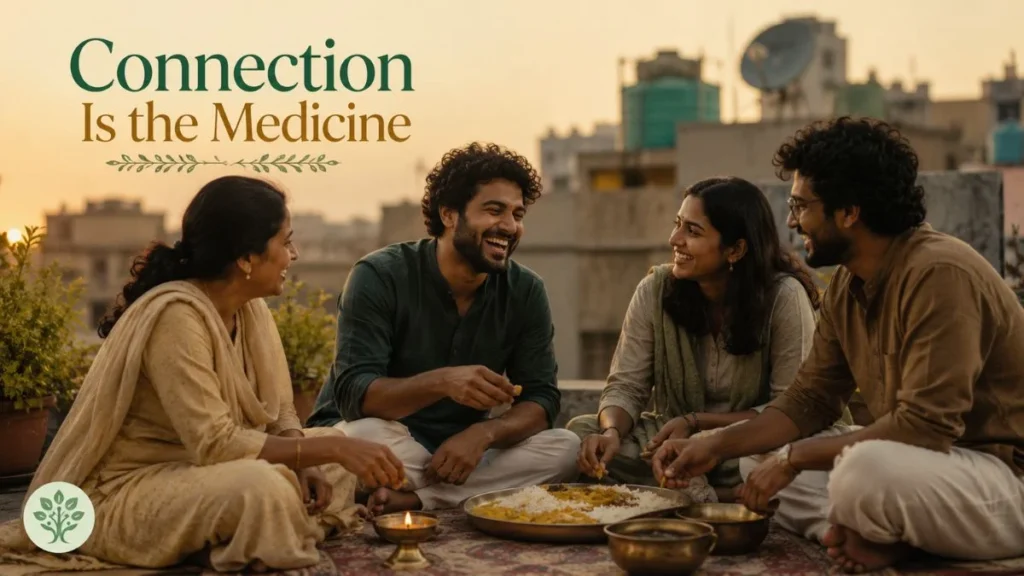
- Start obscenely small. Sangha doesn’t mean finding your tribe of twelve soulmates. It means one person. One shared meal. One regular point of honest contact. My Sangha started as Sunday dinner with a friend who lives twenty minutes away. We cook dal-rice, eat on the floor, and talk about whatever is actually happening in our lives — not the polished version. We’ve missed maybe four Sundays in sixteen months. That single practice did more for my mental state than anything else on this list.
- Prioritise physical proximity. This sounds obvious. It’s not. I had to consciously choose to see people in person when every instinct (and every app) made it easier to text. The oxytocin response requires bodies in rooms. That’s non-negotiable biology.
- Seek regularity over intensity. A weekly 30-minute walk with the same person is worth more than an annual weekend retreat. Ayurveda is obsessive about regularity — Dinacharya (daily routine as medicine) — and that principle extends to social health. Your nervous system needs predictable connection, not occasional intensity.
5 Steps to Reduce Loneliness This Week — Tested, Specific, Real
These aren’t aspirational Pinterest advice. These are things I’ve done myself, with specific costs and time commitments, because vague suggestions help no one.
- Host one meal this Saturday. Text one person today. Invite them for home-cooked food — even if it’s just Maggi and chai. Sit on the floor if you don’t own a dining table. The setting doesn’t matter. The act of feeding someone in your space activates a form of Seva (selfless service) that Ayurveda considers therapeutic. Cost: ₹200–400 in groceries (roughly $2.50–5). Time: 2 hours. Do it before you overthink it.
- Replace one text conversation per day with a 5-minute voice call. Pick the person you texted most yesterday. Call them instead. Notice how your chest feels different during a voice call versus a text exchange. Research consistently shows voice activates bonding circuits that text cannot. This is the lowest-effort, highest-return change on this list.
- Create a two-person walking Satsang. Find one person who will walk with you for 20–30 minutes, twice a week. No earbuds. No phones. Conversation or silence — whatever happens. I do this on Tuesday and Thursday mornings in Cubbon Park with a friend. We’ve had some of the most honest conversations of my adult life during those walks. The combination of movement, nature, and undivided attention is remarkably effective. Cost: ₹0.
- Join one recurring group activity that involves your body. A yoga class. A cooking workshop. A neighbourhood running group. A weekend kirtan. Something where you show up at the same time, with the same people, and your physical body is part of the experience. Routine plus embodiment plus repetition is how trust builds between humans. I joined a weekly yoga class at a local studio — ₹2,500/month ($30) — and within eight weeks, I knew nine people by name. Three have become genuine friends.
- Practise one vulnerability per week. I know this sounds like therapy-speak. Stay with me. Tell one person one honest thing about how you’re actually doing — not the “I’m fine, busy, you know how it is” version. Satsang is built on sat — truth. Connection without honesty is performance. And performance, however polished, produces cortisol, not oxytocin. I started doing this during my Sunday dinners. It was uncomfortable the first time. It’s the reason that friendship now feels genuinely safe.
⚠ When Loneliness Becomes Something That Needs Professional Help
Everything above is genuinely useful for the everyday, modern-life kind of disconnection. The kind where you’re functional but quietly miserable.
But chronic loneliness that doesn’t respond to increased social contact may be signalling something deeper — clinical depression, social anxiety disorder, or complex trauma. Please see a mental health professional if:
- You’ve felt persistently disconnected and emotionally numb for more than a month, even when around people who care about you
- You avoid social situations due to anxiety or fear of judgement — not just a preference for quiet
- You’ve withdrawn from relationships that previously mattered and can’t motivate yourself to re-engage
- You’re using alcohol, substances, or compulsive behaviours (including doomscrolling) to manage the feeling
- You’re having thoughts of self-harm or feeling like you fundamentally don’t matter to anyone
Loneliness is treatable. The conditions it can mask are treatable. There is no moral prize for suffering through it alone — and yes, I recognise the irony of that sentence in an article about connection.
Helplines — Please Use These
- iCall (TISS, India): 9152987821
- Vandrevala Foundation (India, 24/7): 1860-2662-345
- 988 Suicide and Crisis Lifeline (US): Call or text 988
- Crisis Text Line (US / UK): Text HOME to 741741
How to Apply This Today — Start With One Meal, Not a Movement
Don’t try to build a Sangha by Sunday. That’s not how community works. Community grows from one repeated act of showing up — the same person, the same time, the same small ritual, week after week after week.
- Today: Text one person. Invite them for a meal at your place this weekend. Don’t overthink the menu. Don’t clean the house for three hours. Just invite them. Cost: ₹200–400 / roughly $3–5 in groceries.
- Tomorrow: Replace your longest WhatsApp text exchange with a 5-minute phone call. Pay attention to how it feels different in your body.
- This week: Identify one person who might walk with you twice a week. Ask them. Accept that it might feel awkward. Do it anyway.
- This month: Find one recurring group activity within 15 minutes of your home. Attend it three times before deciding if it’s for you. Consistency matters more than perfection.
You don’t need a wellness retreat or a life coach. You need dal-chawal with one friend this Saturday. That’s where Sangha begins.
Your Community Is Your Medicine — And It Always Has Been
The loneliness epidemic won’t be solved by algorithms, apps, or influencers telling you to “put yourself out there.” It’s going to be solved — one person at a time — by the oldest intervention in the human toolkit: showing up for each other. In person. Repeatedly. Honestly.
Ayurveda called this Sangha. Modern neuroscience calls it social connection. The US Surgeon General calls it a public health priority. They’re all pointing at the same need — the need to be seen, heard, and held by people who stay.
Three thousand years of Ayurvedic practice and a growing mountain of peer-reviewed research are converging on one prescription: your community is your medicine. Not a supplement to your medicine. Not a nice addition to your routine. The medicine itself.
I’m still building mine. It’s small — a Sunday dinner, a walking pair, a yoga class, and a handful of people I can be genuinely honest with on a bad day. It’s not impressive on paper. It doesn’t need to be. It just needs to be real.
Who’s in yours?
Frequently Asked Questions
Is loneliness the same as being alone?
No — and this distinction matters enormously. Solitude is a choice and can be deeply restorative. Loneliness is the distressing feeling that your social connections are inadequate — it can hit you at a packed party, a family dinner, or inside a relationship. You can be alone without being lonely, and lonely without being alone. What damages health is the chronic perception of disconnection, not the physical state of being by yourself.
What is Sangha in Ayurveda?
Sangha refers to a community of practice — a small, trusted group of people who share honest presence, mutual support, and aligned intention. In Ayurvedic and yogic traditions, it’s considered a therapeutic element of health, not just a social preference. The classical texts describe isolation as a contributor to Prajnaparadha — patterns of self-destructive behaviour that arise when a person is disconnected from grounding social support.
Does social media help with loneliness?
The evidence is mixed to negative. Passive social media use — scrolling through others’ curated lives — is consistently associated with increased loneliness in research. Active use (direct messaging, meaningful exchanges) may help marginally, but does not produce the oxytocin response that face-to-face interaction does. Digital connection appears to be a deeply incomplete substitute for physical co-presence.
How does loneliness affect physical health?
Chronic loneliness elevates cortisol, drives systemic inflammation, weakens immune function, and increases cardiovascular risk. The 2015 Holt-Lunstad meta-analysis found it raises mortality risk by 26% — comparable to smoking 15 cigarettes daily. It’s also linked to a 50% increased risk of dementia. These are not metaphorical effects — they’re measurable, biological, and dose-dependent.
Can introverts build a Sangha?
Absolutely — and in some ways introverts are better at it. Sangha isn’t about extroversion or large social circles. It’s about depth, not breadth. Two or three people you trust and see regularly is a Sangha. A weekly walk with one person counts. A shared meal counts. Introverts often build the deepest Sanghas because they naturally prioritise quality over quantity — which is exactly what the classical Ayurvedic framework recommends.
References and Sources
- US Surgeon General (2023). Our Epidemic of Loneliness and Isolation. Advisory. US HHS
- Holt-Lunstad J, et al. (2015). Loneliness and social isolation as risk factors for mortality: a meta-analytic review. Perspectives on Psychological Science. PubMed
- Feldman R. (2017). The neurobiology of human attachments. Psychoneuroendocrinology. PubMed
- Sapien Labs (2022). Mental Health Million Project — Global Mind Report. Sapien Labs
- Valtorta NK, et al. (2016). Loneliness and social isolation as risk factors for coronary heart disease and stroke. Heart.
- Cacioppo JT, et al. (2002). Loneliness and health: Potential mechanisms. Psychosomatic Medicine.
- Charaka Samhita — Sutra Sthana, Chapter 11 (on Prajnaparadha and social determinants of health)
- Charaka Samhita — Sharira Sthana, Chapter 1 (on the relationship between individual and community)
Medical Disclaimer
This article is for informational and educational purposes only. It is not intended to be a substitute for professional medical advice, diagnosis, or treatment. Always seek the advice of your physician or other qualified health provider with any questions you may have regarding a medical condition. Never disregard professional medical advice or delay seeking it because of something you have read here.
The Ayurvedic herbs and practices described in this article may not be suitable for everyone. Consult a qualified Ayurvedic practitioner or medical doctor before beginning any new supplement or practice, particularly if you are pregnant, breastfeeding, taking prescription medications, or managing a pre-existing health condition. Ayurvedic treatments are intended to complement — not replace — standard medical care.
If you or someone you know is in mental health distress, please contact a qualified professional or one of the helplines listed above.
