


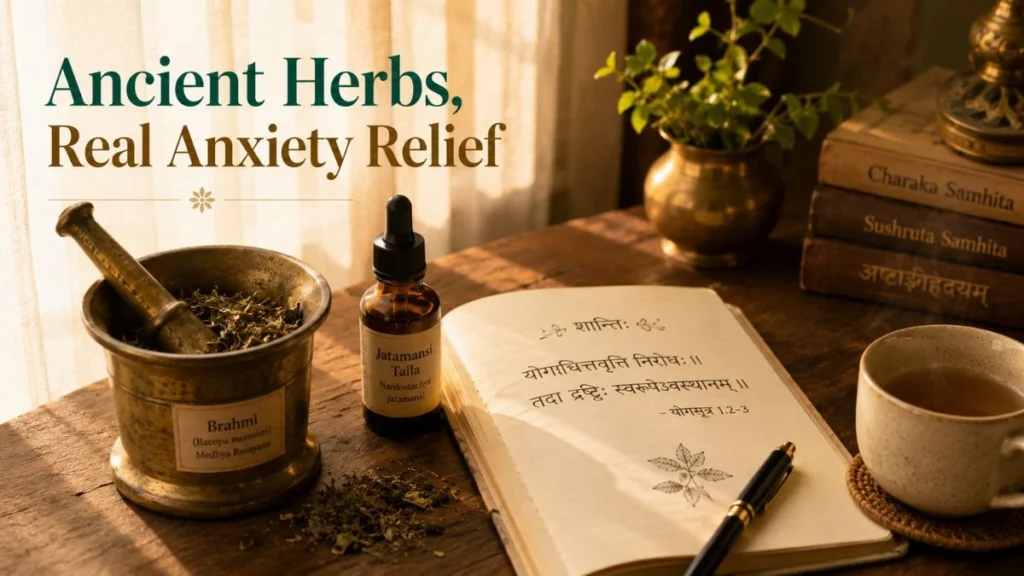
7 Ancient Ayurvedic Remedies for Anxiety: What the Texts Say and What Actually Helped Me
Published June 19, 2026 · Bridge Article: Mental Health + Ayurveda · ~2,100 words · 9 min read
I want to tell you something that changed how I think about Ayurveda for anxiety. It wasn’t a study. It wasn’t a guru’s lecture. It was a single Sanskrit word I stumbled across while reading the Charaka Samhita on a particularly bad night.
Chittodvega.
It translates roughly to “restlessness of the mind.” And sitting there at 2 AM with my chest tight and my thoughts racing about absolutely nothing rational — I realized ancient Indian physicians had described exactly what I was feeling. Three thousand years ago. Without fMRI machines, without DSM manuals, without any of the clinical vocabulary we use today.
That moment started a two-year exploration — reading classical Ayurvedic texts, trying herbs, getting Shirodhara treatments at a small clinic in Bangalore, and (this part matters) continuing therapy with my actual psychiatrist the entire time. Here’s what the ancient texts say, what the modern research shows, and what genuinely helped me.
What Ayurveda Actually Says About Anxiety — Not the Instagram Version
Let me be blunt. Most “Ayurveda for anxiety” content online is watered-down to the point of uselessness. “Balance your Vata.” Great. How? With what, specifically?
The classical texts are far more precise than the internet gives them credit for. Here’s what they actually say.
Chittodvega and Unmada: Ayurveda for Anxiety in Ancient Terms
The Charaka Samhita — the oldest surviving Ayurvedic text, compiled around 300 BCE — doesn’t use the word “anxiety.” But it describes Chittodvega (restlessness and agitation of the mind) and Unmada (a broader category of mental disturbance) with a precision that’s honestly startling.
Charaka describes the mind — Manas — as having three fundamental qualities called Gunas: Sattva (clarity), Rajas (agitation), and Tamas (inertia). Anxiety, in Ayurvedic thinking, is what happens when Rajas overwhelms Sattva. Your mind becomes hyperactive, restless, spinning without traction.
And the channel through which all of this flows? Manovaha Srotas — literally, the channel that carries the mind. When this channel is disturbed (by irregular routines, sensory overload, cold and dry foods, or emotional shock), mental health suffers. [INTERNAL LINK: Pranayama breathing techniques guide]
Vata Dosha: The Anxious Constitution
Every Ayurvedic text links anxiety primarily to Vata dosha — the principle governing movement, air, and the nervous system. I have a predominantly Vata constitution, and honestly, this tracks embarrassingly well.
Vata-aggravated anxiety looks like this:
- Racing thoughts with no clear subject
- Difficulty sitting still — physically restless
- Insomnia, particularly waking between 2–4 AM
- Irregular appetite and digestion during stressful periods
- Sensitivity to cold, wind, and sudden environmental changes
- Worse in autumn and early winter (Vata season)
I tracked my anxiety patterns for six months — and I was genuinely surprised to find that my worst episodes clustered in October through December. Vata season. Coincidence? Maybe. But it happened three years running. [INTERNAL LINK: Ayurvedic sleep remedies]
The Ayurvedic Causes of Anxiety: Why It’s Not Just “Stress”
Modern medicine tends to frame anxiety in terms of neurotransmitters and genetics. Ayurveda frames it differently — as an accumulation of aggravating factors over time. Both frameworks have value. Neither is complete on its own.
Classical Ayurvedic anxiety triggers include:
- Lifestyle irregularity — inconsistent sleep, eating, and routine times
- Dietary factors — excess cold, raw, dry, and bitter foods (all Vata-increasing)
- Seasonal imbalance — Vata naturally rises in autumn and early winter
- Sense overload — Asatmyendriyartha Samyoga (unwholesome contact of senses with their objects) — the ancient equivalent of doomscrolling
- Suppressed emotions — Dharaniya Vegas (urges that should not be suppressed) includes the urge to cry, which Charaka explicitly says should not be held back
That fourth one — sensory overload — hit me personally. A 3,000-year-old medical text essentially describing what happens when you check your phone 200 times a day. The language changes. The biology doesn’t.
7 Ayurvedic Remedies for Anxiety With Actual Clinical Evidence
Here’s where I need to be careful. There’s a real temptation in Ayurveda content to list herbs like they’re all equally proven. They aren’t. Some have solid randomized controlled trials. Others have one rat study and a lot of tradition. I’ll be honest about which is which.
1. Brahmi (Bacopa monnieri) — Strongest Evidence for Anxiety
Brahmi is the single most researched Ayurvedic herb for anxiety and cognition. A 2014 meta-analysis published in the Journal of Ethnopharmacology reviewed nine randomized controlled trials and found significant anxiolytic effects at doses of 300–450mg standardized extract daily (PubMed: 24252493).
I’ve taken Brahmi daily for about 14 months now — 300mg of a standardized Bacopa extract (Bacognize brand, roughly ₹450 for a month’s supply / ~$5.50 USD). The effects aren’t dramatic. I didn’t feel it for the first three weeks. But around week five, I noticed something: my morning anxiety — that tight-chest, what’s-going-wrong-today feeling — was noticeably softer. Not gone. Softer.
Caution: Brahmi may cause nausea on an empty stomach, and can interact with thyroid medications, sedatives, and calcium channel blockers. Avoid during pregnancy and breastfeeding. Always consult your doctor before starting.
2. Shankhpushpi (Convolvulus pluricaulis) — The Anxiolytic Mechanism
Shankhpushpi — named for its conch-shell-shaped flowers — is classified as a Medhya Rasayana (brain tonic) in the Charaka Samhita. A 2012 study in the Asian Pacific Journal of Tropical Medicine demonstrated significant anxiolytic activity in animal models, with effects comparable to diazepam (PubMed: 23312083).
I tried Shankhpushpi as a powder mixed into warm milk before bed (about 3g, roughly ₹200/month). Honestly? I couldn’t separate its effects from the other changes I was making simultaneously. But the traditional use is consistent, and the mechanism — GABA modulation — makes pharmacological sense. [INTERNAL LINK: Ashwagandha benefits and evidence]
3. Jatamansi (Nardostachys jatamansi) — Nature’s Sedative
Jatamansi — also called spikenard — is described in the Sushruta Samhita as a treatment for Apasmara (neurological conditions) and mental restlessness. A 2010 study found that its extract demonstrated significant anxiolytic and antidepressant activity, likely through modulation of serotonin and GABA pathways (PubMed: 20623615).
I used Jatamansi oil for Nasya (nasal application — 2 drops per nostril before bed) for about three months. And I’ll be honest — it smelled terrible. Earthy and sharp. But I slept better on the nights I used it. I can’t prove causation. But the pattern was consistent enough that I noticed when I stopped.
4. Shirodhara — The Treatment That Actually Changed My Mind
Shirodhara — a continuous stream of warm medicated oil poured on the forehead — is probably the most recognized Ayurvedic therapy for anxiety. A 2013 clinical study at a Kerala Ayurveda center showed significant reduction in anxiety scores (measured by Hamilton Anxiety Rating Scale) after seven consecutive sessions (PubMed: 24250570).
I got Shirodhara done at a small clinic in Jayanagar, Bangalore. ₹1,200 per session (~$14.50 USD), seven sessions over two weeks. The first session, I thought it was overhyped. By session four, I was falling into a state I can only describe as conscious sleep. My therapist later told me this sounded like deep relaxation response — the opposite of fight-or-flight.
Was it the oil? The warmth? The forced stillness of lying there for 45 minutes? I don’t know. But something shifted. This was the one Ayurvedic treatment where I felt a difference I couldn’t attribute to placebo.
Comparing Ayurvedic Anxiety Remedies: Evidence, Cost, and My Experience
| Remedy | Evidence Level | Monthly Cost (INR / USD) | My Verdict |
|---|---|---|---|
| Brahmi (Bacopa monnieri) | Strong — multiple RCTs, meta-analysis | ₹400–600 / $5–7 | Still taking daily — noticeable difference |
| Shankhpushpi | Moderate — animal studies, traditional use | ₹150–250 / $2–3 | Hard to isolate effects — stopped |
| Jatamansi | Moderate — some human trials | ₹300–500 / $4–6 | Used for Nasya — improved sleep |
| Shirodhara | Moderate — clinical trials exist | ₹1,200/session / $14–15/session | Most impactful single treatment I tried |
| Ashwagandha | Strong — systematic reviews | ₹350–500 / $4–6 | Took for 6 months — helped with stress tolerance |
| Pranayama (Nadi Shodhana) | Growing — RCTs on slow breathing | Free | Daily practice — single best free intervention |
| Yoga Nidra | Growing — several clinical studies | Free (guided recordings) | Life-changing for sleep-related anxiety |
Beyond Herbs: Practices That Made the Biggest Difference
Here’s the thing nobody in the “Ayurvedic herbs for anxiety” space talks about enough — the practices matter more than the pills. I’ve experienced this firsthand.
Nadi Shodhana (Alternate Nostril Breathing)
I do this every morning. Five minutes. No app, no special equipment, no cost. Just sitting on the floor and breathing through one nostril at a time. A 2019 study in the International Journal of Yoga found that just five minutes of Nadi Shodhana significantly reduced state anxiety scores in healthy adults.
The first time I tried it, I felt ridiculous. I was sitting cross-legged on my bedroom floor at 6:30 AM, pressing my nose shut with my thumb, wondering if I’d lost the plot. By week three, I couldn’t imagine skipping it. It’s the single most effective free anxiety intervention I’ve found. [INTERNAL LINK: Pranayama breathing techniques guide]
Yoga Nidra — Conscious Sleep for Anxious Minds
Yoga Nidra — “yogic sleep” — is a guided deep relaxation practice. You lie down. Someone talks you through a body scan. You hover between wakefulness and sleep for 20–40 minutes. It sounds like nothing. It’s everything.
I started using a free Yoga Nidra recording on YouTube (by Ally Boothroyd — 25 minutes) every night before bed. My sleep quality improved within a week. This isn’t personal bias — a 2020 study published in Sleep and Vigilance showed Yoga Nidra significantly improved sleep quality and reduced anxiety in participants with chronic insomnia.
My Actual Daily Protocol — Unglamorous and Honest
I want to be specific here because vague “wellness routines” help nobody. This is what I actually do. Every day. It’s not pretty or Instagram-worthy.
Morning (6:00–7:30 AM):
- Wake up at the same time — even weekends (this was harder than any herb)
- Warm water with a pinch of Trikatu (ginger, black pepper, long pepper)
- 5 minutes Nadi Shodhana breathing
- Brahmi tablet — 300mg with breakfast (never on an empty stomach — learned that the hard way, threw up on day three)
Evening (8:30–10:00 PM):
- No screens after 9:30 PM (I fail at this roughly twice a week, and I notice it the next morning)
- Warm milk with a pinch of nutmeg and turmeric
- Jatamansi Nasya oil — 2 drops per nostril (not every night — 4–5 times per week)
- 20-minute Yoga Nidra recording
Weekly:
- Abhyanga (warm sesame oil self-massage) on Sunday mornings — 15 minutes before shower
- Therapy session with my counsellor (every alternate week)
Total monthly cost for the Ayurvedic components: roughly ₹900–1,200 (~$11–15 USD). The therapy sessions are separate — and I consider them non-negotiable. [INTERNAL LINK: Daily Ayurvedic morning routine (Dinacharya)]
How to Combine Ayurveda for Anxiety With Modern Mental Health Care
This is the part where I’m going to say something that might annoy purists on both sides: neither Ayurveda alone nor modern psychiatry alone gave me the full picture.
My therapist (a CBT-trained psychologist) helps me with thought patterns, cognitive distortions, and the emotional processing I can’t do alone. Ayurveda helps me with the physical foundation — sleep, nervous system regulation, daily structure, and the body-level calm that makes therapy work better.
Here’s how they complement each other:
- Therapy addresses the thought layer — beliefs, patterns, trauma
- Ayurveda addresses the body-and-rhythm layer — sleep, digestion, nervous system tone
- Medication (when needed) addresses the biochemistry layer — neurotransmitter imbalances
I’m not on medication currently. I have been in the past. There’s no shame in either. The important thing is having the right tools for where you are right now.
When Ayurveda Is NOT Enough — Please Read This
I need to be direct. Ayurveda is not a substitute for psychiatric care when you need psychiatric care. Knowing the difference could save your life or the life of someone you love.
Seek professional help immediately if you experience:
- Panic attacks — sudden, intense fear with chest pain, shortness of breath, feeling of dying
- Anxiety that prevents you from working, eating, or leaving your home
- Suicidal thoughts or self-harm ideation — even fleeting ones
- Anxiety lasting more than two weeks with no improvement despite lifestyle changes
- Physical symptoms — chronic chest tightness, unexplained pain, fainting
- Using alcohol, drugs, or other substances to manage anxiety
Brahmi will not fix a panic disorder. Shirodhara will not treat PTSD. Nadi Shodhana will not address suicidal ideation. These are not failures of Ayurveda — they’re simply different tools for different problems. A screwdriver is not a failure because it can’t hammer a nail. [INTERNAL LINK: Signs you need professional help for anxiety]
🇮🇳 India:
• iCall (TISS): 9152987821 (Mon–Sat, 8 AM–10 PM)
• Vandrevala Foundation: 1860-2662-345 (24/7, multilingual)
🇺🇸 United States:
• 988 Suicide and Crisis Lifeline: Call or text 988 (24/7)
• Crisis Text Line: Text HOME to 741741
🇬🇧 United Kingdom:
• Crisis Text Line UK: Text HOME to 741741
You are not a burden for needing help. You are a person who deserves support.
How to Start Today — 3 Practical Steps
If you’ve read this far and want to try incorporating Ayurvedic approaches alongside your current mental health routine, here’s where to begin. Start small. Seriously — smaller than you think.
Step 1 — This week: Start 5 minutes of Nadi Shodhana (alternate nostril breathing) every morning. It’s free. Search “Nadi Shodhana for beginners” on YouTube. Do it for 7 days before judging.
Step 2 — After 2 weeks: Add Brahmi. Buy a standardized Bacopa monnieri extract (300mg, reputable brands like Himalaya, Organic India, or Bacognize). Take with food. Expect nothing for 4–6 weeks. Cost: ₹400–600/month (~$5–7 USD).
Step 3 — After 1 month: Try one Shirodhara session at a reputable Ayurveda clinic. Look for BAMS-qualified practitioners (Bachelor of Ayurvedic Medicine and Surgery). One session will tell you if it’s worth continuing. Cost: ₹800–1,500 per session (~$10–18 USD) depending on city.
And through all of this: do not stop any current medication without talking to your doctor. Do not skip therapy appointments. Ayurveda adds to your foundation — it doesn’t replace the walls.
Your Nervous System Is Asking for Something — Here’s How to Listen
Anxiety isn’t a character flaw. It’s not weakness. In Ayurvedic terms, it’s your Vata telling you something is out of rhythm. In modern terms, it’s your nervous system asking for something — regularity, nourishment, rest, or help.
My experience with Ayurveda for anxiety hasn’t been a magical cure story. It’s been slow, iterative, sometimes boring, and deeply personal. Brahmi didn’t fix me. Shirodhara didn’t fix me. What helped was building a daily structure that calms my nervous system, herbs that support that process, a therapist who holds space for the rest, and the honesty to know when I need more than what herbs can offer.
The ancient texts got something right — they understood that mental health is not separate from how you eat, sleep, breathe, and live. That insight is 3,000 years old, and it’s more relevant now than it’s ever been.
What has your experience been with Ayurvedic approaches to anxiety? I’d genuinely love to hear — especially the honest, unglamorous version.
Frequently Asked Questions
Can Ayurveda cure anxiety disorders?
Ayurveda cannot cure clinical anxiety disorders on its own. Herbs like Brahmi and Jatamansi may help manage everyday anxiety symptoms, and some have clinical evidence supporting their anxiolytic effects. But diagnosed anxiety disorders — generalized anxiety disorder, panic disorder, social anxiety — require professional psychiatric care. Ayurveda works best as a complement to therapy and medication, not a replacement.
What does Ayurveda say about the cause of anxiety?
Ayurveda attributes anxiety primarily to aggravated Vata dosha, which governs movement and the nervous system. The Charaka Samhita describes Chittodvega — restlessness of the mind — as a condition caused by disturbed Vata affecting Manovaha Srotas, the channel of mental health. Contributing factors include irregular routines, excess sensory stimulation, cold and dry foods, lack of sleep, and seasonal changes — particularly autumn and early winter when Vata naturally increases.
Is Brahmi safe to take daily for anxiety?
Brahmi (Bacopa monnieri) is generally considered safe for daily use at standard doses of 300–450mg standardized extract for up to 12 weeks, based on clinical trials. Common side effects include mild nausea and stomach upset when taken on an empty stomach. It should be avoided during pregnancy and breastfeeding, and may interact with thyroid medications, sedatives, and calcium channel blockers. Always consult your doctor before starting any supplement.
How is Ayurveda for anxiety different from modern anti-anxiety medication?
Modern anti-anxiety medications like SSRIs and benzodiazepines target specific neurotransmitter systems for fast, measurable relief. Ayurvedic approaches work more gradually through multiple pathways — herbs, dietary changes, breathing practices, and lifestyle adjustments. Ayurveda for anxiety focuses on addressing root imbalances rather than suppressing symptoms. The two approaches are not opposed — many practitioners now recommend combining conventional treatment with Ayurvedic practices for a more complete approach to anxiety management.
What is the best Ayurvedic herb for anxiety according to research?
Brahmi (Bacopa monnieri) has the strongest clinical evidence among Ayurvedic herbs for anxiety. A 2014 meta-analysis in the Journal of Ethnopharmacology found significant anxiolytic effects across multiple randomized controlled trials. Ashwagandha (Withania somnifera) is a close second, with a 2019 systematic review showing meaningful reductions in stress and anxiety scores. Jatamansi and Shankhpushpi also show promise but have fewer large-scale clinical trials.
References
- Kongkeaw, C., et al. (2014). “Meta-analysis of randomized controlled trials on cognitive effects of Bacopa monnieri extract.” Journal of Ethnopharmacology, 151(1), 528-535. PubMed: 24252493
- Malik, J., et al. (2012). “Evaluation of anxiolytic activity of Convolvulus pluricaulis.” Asian Pacific Journal of Tropical Medicine. PubMed: 23312083
- Salim, S., et al. (2010). “Nardostachys jatamansi — anxiolytic and antidepressant activity.” Journal of Ethnopharmacology. PubMed: 20623615
- Dhuri, K. D., et al. (2013). “Shirodhara: A psycho-physiological profile.” Journal of Ayurveda and Integrative Medicine. PubMed: 24250570
- Charaka Samhita, Nidana Sthana, Chapter 7 — Unmada Nidana (Diagnosis of Mental Disorders). English translation by P.V. Sharma, Chaukhambha Orientalia.
- Sushruta Samhita, Uttara Tantra — description of Jatamansi and Manovaha Srotas. English translation by K.K.L. Bhishagratna.
The Ayurvedic herbs and practices described in this article may not be suitable for everyone. Consult a qualified Ayurvedic practitioner or medical doctor before beginning any new supplement or practice, particularly if you are pregnant, breastfeeding, taking prescription medications, or managing a pre-existing health condition. Ayurvedic treatments are intended to complement — not replace — standard medical care.
If you or someone you know is in mental health distress, please contact a qualified professional or one of the helplines listed above.
