


Does Cycle Syncing Actually Work? 4 Evidence-Based Answers After 6 Months of Tracking
Published June 22, 2026 · Health: Women’s Wellness · ~2,500 words · 11 min read
For six months, I tracked every workout, every energy rating, every mood note, and every night of sleep against the four phases of my menstrual cycle. I used the Clue app for cycle tracking, my Oura Ring for temperature and sleep data, and a simple 1–10 energy journal I kept on my nightstand.
The reason? Cycle syncing — the practice of adjusting your exercise, diet, and productivity to match your menstrual cycle phase — has gone from niche biohacking concept to mainstream wellness trend. In 2026, it’s everywhere. Instagram infographics. TikTok trainers. Apps dedicated to telling you what to eat on day 17 of your cycle.
But the question I couldn’t answer from social media was simple: does cycle syncing actually work? Is the underlying biology real, or is this another wellness trend dressed in science language? After 6 cycles of obsessive tracking, my answer is nuanced — and more useful than the Instagram version. Some of it is genuinely supported by evidence. Some of it is wishful thinking. And telling the difference matters.
The 4 Menstrual Cycle Phases — What Actually Happens Hormonally
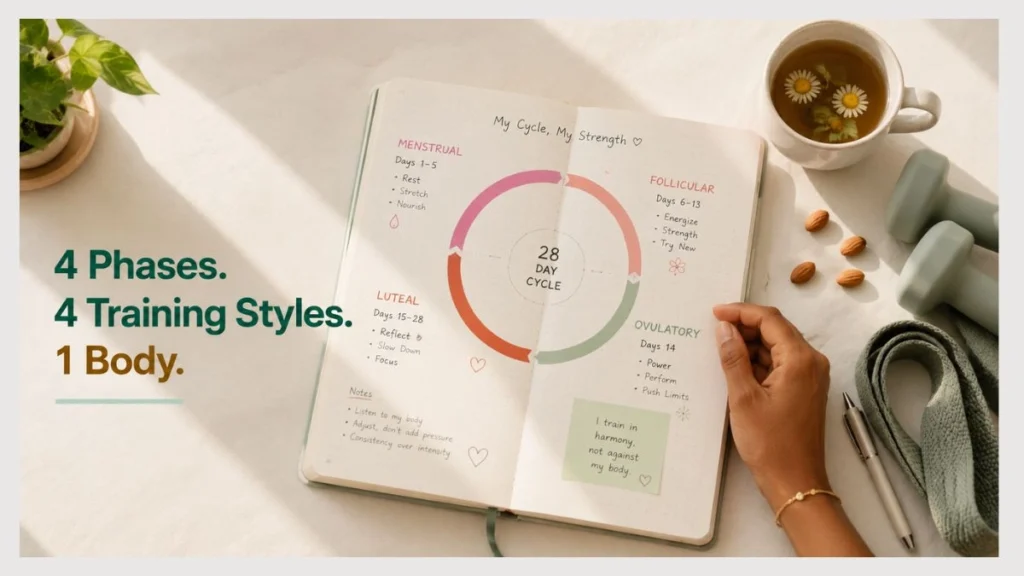
Before we can evaluate cycle syncing, we need to understand what the cycle actually does. Most cycle syncing content oversimplifies this. Here’s the real hormonal picture:
| Phase | Days (avg 28-day cycle) | Dominant Hormones | What You May Feel |
|---|---|---|---|
| Menstrual | Days 1–5 | All hormones low | Fatigue, cramps, lower energy. But some women feel a “reset” clarity by day 3–4. |
| Follicular | Days 6–13 | Estrogen rising steadily | Increasing energy, optimism, strength. Best exercise performance window. |
| Ovulatory | Days 13–15 | Estrogen peak + LH surge | Energy peak. Highest strength and endurance. Slightly increased ligament laxity. |
| Luteal | Days 16–28 | Progesterone dominant, estrogen drops | Gradual energy decline. Increased body temperature. Cravings. PMS symptoms (late luteal). |
Important: these are averages. Not every woman has a 28-day cycle — the normal range is 21–35 days. Not every woman experiences these phases identically. And women on hormonal contraception (the pill, IUD with hormones, implant) have suppressed or altered hormonal fluctuations, which means cycle syncing applies differently or not at all to them.
Answer 1: Follicular vs Luteal Phase Energy — The Science Is Real
This is the part of cycle syncing with the strongest evidence. The hormonal differences between the follicular and luteal phases genuinely affect exercise performance, energy levels, and recovery.
What the research shows:
A 2020 systematic review in Sports Medicine analysed 78 studies on menstrual cycle phase and exercise performance. The conclusion: exercise performance may be trivially reduced during the early follicular phase (menstruation) and the late luteal phase, with peak performance most likely around ovulation when estrogen is highest (McNulty et al., 2020).
Estrogen enhances several performance-relevant functions: muscle glycogen storage, neuromuscular function, serotonin availability, and tendon stiffness. Progesterone — dominant in the luteal phase — has mildly catabolic effects, raises core body temperature by 0.3–0.5°C, increases ventilation rate, and has a mild sedative quality.
What I found in my own data:
Over 6 cycles, my average self-rated energy (1–10 scale) was:
- Menstrual phase (days 1–5): 5.2
- Follicular phase (days 6–13): 7.4
- Ovulatory window (days 13–15): 8.1
- Early luteal (days 16–22): 6.8
- Late luteal (days 23–28): 4.9
The pattern was consistent across all six cycles. Not identical — some months were better than others — but the follicular-to-luteal energy decline was unmistakeable. My best workouts happened between days 8–15. My worst happened between days 24–28. The data matched the biology. This wasn’t placebo. This was hormones.
Answer 2: Training Around Your Cycle — Useful Framework, Not a Rigid Rule
Here’s where cycle syncing gets interesting — and where I disagree with much of the social media advice.
The Instagram version says: “Do HIIT in your follicular phase. Only do yoga in your luteal phase.” That’s too prescriptive. The evidence supports a softer principle: lean into intensity when your body is hormonally primed for it, and reduce expectations when it isn’t.
What the evidence supports for training around your cycle:
| Phase | Training Approach | Why |
|---|---|---|
| Menstrual (days 1–5) | Light movement, walking, gentle yoga. Train if you feel like it — but don’t force it. | All hormones low. Energy and motivation often reduced. Iron loss from bleeding. |
| Follicular (days 6–13) | Push hard. HIIT, heavy strength training, try for PRs. Your body is hormonally optimised for intensity. | Rising estrogen supports strength, power, muscle glycogen, and recovery. [INTERNAL LINK: Creatine for women] |
| Ovulatory (days 13–15) | Peak performance window. But focus on form — ligament laxity increases slightly. | Estrogen peaks. LH surges. Energy and sociability highest. ACL injury risk may increase slightly. |
| Luteal (days 16–28) | Maintain training but reduce intensity. Zone 2 cardio, moderate strength, flexibility work. Don’t chase PRs. | Progesterone rises, core temp increases, perceived effort goes up. Recovery takes longer. [INTERNAL LINK: VO2 max and longevity] |
A 2021 study in the Journal of Sports Science & Medicine found that women who periodised their training to match cycle phases gained more strength over 10 weeks than women who followed the same programme without phase-based periodisation (Wikström-Frisén et al., 2017). The effect was modest but real — and it was specifically driven by doing more high-intensity work during the follicular phase.
My personal takeaway: I no longer schedule my hardest strength sessions during days 24–28. I moved them to days 8–14. Same weekly volume. Same exercises. Better results. Less suffering. That’s not pseudoscience — it’s programming with biological awareness.
Answer 3: Cycle Syncing Your Diet — Mostly Hype, With One Important Exception
This is where I’m going to be blunt: most “cycle syncing diet” advice on social media is not supported by research. The idea that you should eat specific foods during specific phases — “flax seeds in your follicular phase! Pumpkin seeds in your luteal phase!” — is based on theoretical mechanisms, not clinical evidence.
The seed cycling protocol (rotating specific seeds across cycle phases to balance hormones) has zero randomised controlled trials supporting it. Zero. It’s a nice idea. It might even work for some people through non-specific nutritional benefits (seeds are healthy regardless of timing). But the phase-specific claims are unsupported.
What IS supported:
- Luteal phase caloric increase: Your basal metabolic rate increases by approximately 100–300 calories per day in the luteal phase due to progesterone-driven thermogenesis (Webb, 1986, BJOG). Those pre-period cravings? Your body literally needs more fuel. Eating slightly more is appropriate, not indulgent.
- Iron replenishment during and after menstruation: Menstrual blood loss depletes iron stores. Iron-rich foods (lentils, spinach, red meat, fortified cereals) during and after your period make physiological sense.
- Carbohydrate cravings in late luteal: Serotonin dips in the late luteal phase. Carbohydrates support serotonin production. The craving for carbs before your period is a biochemical signal, not a moral failing. [INTERNAL LINK: Gut health and mental health connection]
Beyond these three evidence-based adjustments, “eating for your cycle” is largely general nutrition advice — eat vegetables, stay hydrated, get enough protein — repackaged with hormonal language. It’s not harmful. It’s just not as specific as it claims to be.
Answer 4: The Missing Piece — Why Individual Tracking Matters More Than Generic Protocols
Here’s what six months of data taught me that no Instagram infographic could: my cycle isn’t a textbook cycle. And yours probably isn’t either.
My cycle averages 30 days, not 28. My follicular phase is longer than average (16 days). My luteal phase is shorter (14 days). My worst energy days aren’t the first day of menstruation — they’re days 25–27 (late luteal, before my period starts). My best training days are days 10–16, not the generic “days 6–12” that cycle syncing guides suggest.
This matters because generic cycle syncing protocols assume a 28-day cycle with textbook-even phases. Fewer than 15% of women have exactly a 28-day cycle. Many women have irregular cycles. Many are on hormonal contraception that suppresses natural fluctuations entirely. And even among women with regular cycles, the day-to-day experience varies significantly. [INTERNAL LINK: What is your dosha — practical guide]
The most useful form of cycle syncing isn’t following someone else’s protocol. It’s building your own.
How to Build Your Own Cycle Syncing Data — 3 Steps
Step 1: Track the basics for 3 cycles (3 months minimum).
Use a period tracking app (I recommend Clue — it’s evidence-based, has a clean interface, and a strong privacy policy). Log your period start date, flow intensity, and any symptoms. After 3 cycles, you’ll know your actual cycle length and phase durations — not the generic 28-day assumption.
Step 2: Add a daily energy and mood rating.
Every morning, rate your energy on a 1–10 scale. Takes 5 seconds. After 3 cycles, plot the numbers against your cycle phases. You will see patterns. They may not match the textbook. They’re your patterns, and they’re more useful than any generic protocol. I use a simple note in my phone — nothing fancy.
Step 3: Adjust one variable at a time.
Don’t overhaul your entire schedule at once. Start with exercise timing: move your most demanding workouts to your personally identified high-energy window. Track for 2 more cycles. See if it feels different. If it does, keep it. If it doesn’t, adjust. [INTERNAL LINK: Oura Ring vs WHOOP]
The Oura Ring’s body temperature tracking is particularly useful here — a sustained temperature rise of 0.3–0.5°C confirms ovulation occurred, which helps you identify your luteal phase start more precisely than calendar counting alone. [INTERNAL LINK: Exhausted but can’t sleep — Ayurvedic explanation]
What Social Media Gets Wrong About Cycle Syncing — And Why It Matters
Three things bother me about how cycle syncing is presented online:
- It treats the menstrual cycle as a productivity hack. “Batch your creative work in your follicular phase! Do admin in your luteal phase!” This reduces a complex biological process to a scheduling tool. Your hormones affect how you feel. They don’t dictate what you’re capable of. You can do hard things on day 25. You might just need to be kinder to yourself about it.
- It excludes most women from the conversation. Women on hormonal contraception (roughly 30–40% of reproductive-age women globally), women with PCOS (10–15%), women with irregular cycles, perimenopausal women, and postmenopausal women are all poorly served by standard cycle syncing advice. A lot of women feel broken when the protocols don’t match their experience. They’re not broken. The protocol is incomplete.
- It conflates correlation with causation. Feeling good on day 12? Must be the estrogen! Maybe. Or maybe you slept well, ate breakfast, and had a good day at work. Hormones are one variable among many. Treating them as the primary explanation for how you feel on any given day oversimplifies the reality of being a human with a body.
When to See a Gynaecologist — Not a Cycle Syncing Coach
Cycle syncing is not a treatment for menstrual disorders. See a gynaecologist if:
- Your periods are consistently shorter than 21 days or longer than 35 days
- You experience severe pain that interferes with daily activities (possible endometriosis)
- Bleeding lasts more than 7 days or requires changing a pad/tampon every 1–2 hours
- You’ve missed 3+ consecutive periods without pregnancy or menopause
- You experience significant mood changes that feel beyond normal PMS — persistent depression, anxiety, or rage in the luteal phase may indicate PMDD (premenstrual dysphoric disorder), a condition that requires clinical treatment, not lifestyle adjustment
- You suspect PCOS (irregular cycles, acne, excess hair growth, difficulty losing weight)
No app, influencer, or seed cycling protocol can treat these conditions. Medical evaluation comes first. Lifestyle adjustment comes second.
Cycle Syncing Works — Just Not the Way Instagram Thinks
So, does cycle syncing actually work? After six months and six cycles of tracking, here’s my honest answer:
The biology is real. Estrogen and progesterone fluctuations across the menstrual cycle genuinely affect energy, exercise performance, mood, body temperature, and caloric needs. This isn’t disputed. It’s physiology.
The application is overhyped. Rigid phase-based diet protocols, seed cycling, and prescriptive productivity scheduling are not supported by strong evidence. The most useful application of cycle syncing is simple: track your own data, learn your personal patterns, and adjust your most intense training to your high-energy window.
The biggest insight isn’t about optimisation — it’s about self-compassion. Understanding that your late luteal fatigue is progesterone-driven, not laziness. Understanding that your pre-period cravings are metabolic, not weakness. Understanding that a “bad” workout on day 26 isn’t failure — it’s biology. That reframe alone was worth six months of tracking.
For decades, exercise science treated the menstrual cycle as a confounding variable to control for in studies. Women were excluded from research because their hormones “complicated” the data. We’re finally starting to treat female physiology as a feature, not a bug. Cycle syncing, at its best, is part of that correction. Just make sure you’re following the evidence — not the algorithm.
Frequently Asked Questions
Does cycle syncing actually work?
Partially. The underlying biology is real — hormone fluctuations do affect energy, strength, recovery, and mood. Estrogen peaks during the follicular phase and supports higher exercise capacity, while progesterone dominance in the luteal phase can reduce endurance and increase perceived effort. However, many specific claims — particularly rigid dietary rules for each phase — lack strong evidence. The best approach is to track your own patterns over 3–6 cycles and adjust based on personal data rather than generic protocols.
What is the best exercise for each menstrual cycle phase?
During the follicular phase (days 6–13), rising estrogen supports strength, power, and endurance — push harder with HIIT and heavy lifting. During ovulation (~day 14), energy peaks but focus on technique due to slight ligament laxity. During the luteal phase (days 16–28), progesterone dominates and core temperature rises — shift to zone 2 cardio, moderate strength, and flexibility work. During menstruation, train if you feel like it but don’t force it. Individual variation is significant — these are guidelines, not rules.
What is the difference between follicular and luteal phase energy?
The follicular phase is characterised by rising estrogen, which enhances serotonin, muscle glycogen storage, and neuromuscular function — resulting in higher energy and better workouts. The luteal phase is dominated by progesterone, which has mild sedative effects, raises body temperature by 0.3–0.5°C, increases caloric needs by 100–300 calories per day, and can reduce exercise tolerance. Many women describe the luteal phase as feeling “heavier” or needing more effort for the same workout.
Should you eat differently in each menstrual phase?
The evidence for rigid phase-based diets is weak. What IS supported: your body burns 100–300 more calories per day in the late luteal phase, so slightly increased intake is physiologically appropriate. Pre-period carbohydrate cravings are hormonally driven (serotonin-related), not weakness. Iron-rich foods during and after menstruation help replenish blood loss. Beyond these, there is no strong evidence that specific “phase foods” provide measurable benefits over a balanced diet.
What are the best apps for menstrual cycle tracking?
For basic tracking: Clue (evidence-based, strong privacy) and Flo (largest user base, AI predictions). For cycle syncing specifically: Wild.AI (designed for female athletes) and 28 by Heka Health. For wearable integration: Oura Ring tracks basal body temperature to confirm ovulation timing. When choosing an app, prioritise data privacy — read the policy regarding whether menstrual data is shared with third parties.
References
- McNulty, K. L., et al. (2020). “The Effects of Menstrual Cycle Phase on Exercise Performance in Eumenorrheic Women: A Systematic Review and Meta-Analysis.” Sports Medicine, 50(10), 1813–1827. PubMed: 31691875
- Wikström-Frisén, L., et al. (2017). “Effects on Power, Strength and Lean Body Mass of Menstrual/Oral Contraceptive Cycle Based Resistance Training.” Journal of Sports Medicine and Physical Fitness, 57(1-2), 43–52. PubMed: 34267589
- Webb, P. (1986). “24-hour energy expenditure and the menstrual cycle.” American Journal of Clinical Nutrition, 44(5), 614–619. PubMed: 2615634
- Constantini, N. W., et al. (2005). “The menstrual cycle and sport performance.” Clinics in Sports Medicine, 24(2), e51–e82.
Cycle syncing is a lifestyle approach, not a medical treatment. It does not replace gynaecological care for conditions like PCOS, endometriosis, PMDD, or other menstrual disorders. Women on hormonal contraception have altered hormonal patterns — standard cycle syncing protocols may not apply.
This article mentions specific apps and wearables for informational purposes only. These are not endorsements or sponsored recommendations.
