


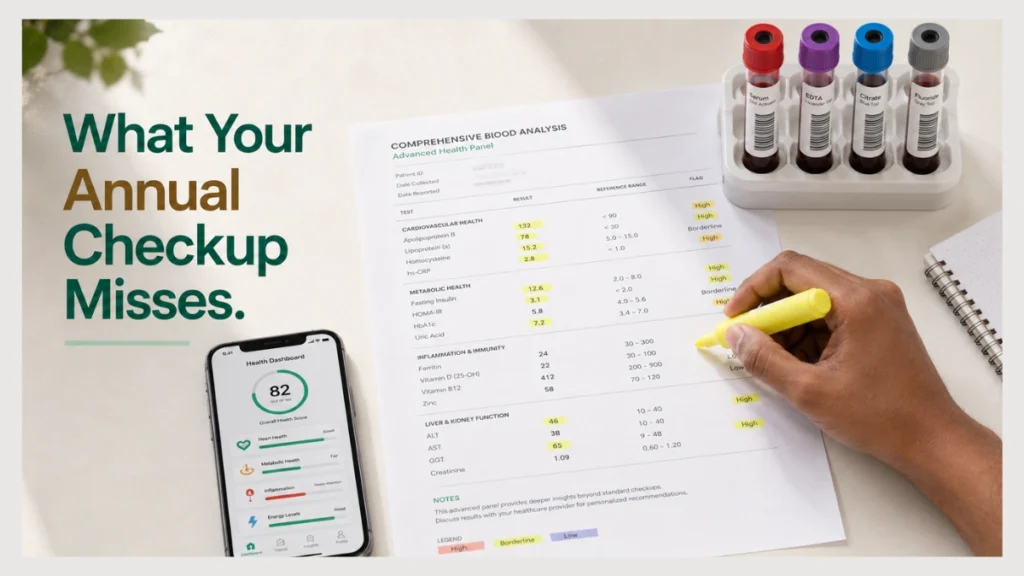
7 Blood Tests Your Doctor Doesn’t Order — But Probably Should
Published June 22, 2026 · Health: Preventive Medicine · ~2,500 words · 11 min read
Last year, I went for my annual health checkup. CBC, lipid panel, fasting glucose, liver function, kidney function, thyroid (TSH only), urine routine. The doctor said everything was “normal.” I paid ₹3,500, took my report home, and filed it away feeling reassured.
Then I read Peter Attia’s Outlive. Then I started looking at what longevity-focused physicians actually test for. Then I ordered seven additional blood tests your doctor doesn’t order — tests that most standard annual panels completely ignore — and discovered that “normal” was hiding a few things I very much needed to know about.
My fasting glucose was 88 mg/dL. Normal. My fasting insulin — a test my doctor had never ordered in 15 years of annual checkups — was 14.2 μIU/mL. Not normal. That number suggests early insulin resistance, even with perfect glucose. It’s the metabolic smoke before the diabetes fire. And my standard panel missed it entirely.
Here are the seven tests I now order every year, what each one reveals that standard panels miss, and what they cost. Most are shockingly affordable. The question isn’t whether you can afford them — it’s why your doctor isn’t ordering them already.
Why Your Annual Blood Work Misses Critical Markers
Standard annual health panels were designed for population-level screening, not individual optimisation. They’re excellent at detecting acute illness and end-stage disease. They’re poor at detecting the early metabolic dysfunction that precedes disease by 10–20 years.
The typical annual panel in India includes:
- CBC (complete blood count) — detects anaemia, infection, blood disorders
- Fasting glucose — detects diabetes (but only after your pancreas has already failed to compensate)
- Lipid panel (total cholesterol, LDL, HDL, triglycerides) — crude cardiovascular risk assessment
- Liver function (ALT, AST) — detects liver damage
- Kidney function (creatinine, BUN) — detects kidney impairment
- TSH — basic thyroid screening
What it doesn’t include: markers for chronic inflammation, early insulin resistance, cardiovascular particle risk, vitamin deficiencies, complete thyroid function, or methylation status. These are the markers that longevity medicine considers essential — and they’re the ones that catch problems before symptoms appear.
The 7 Blood Tests Your Doctor Doesn’t Order — Explained
1. hs-CRP (High-Sensitivity C-Reactive Protein) — The Inflammation Signal
What it measures: Chronic, low-grade systemic inflammation — the slow-burning fire linked to heart disease, cancer, autoimmune conditions, and metabolic syndrome.
Why your doctor doesn’t order it: Standard CRP tests detect acute inflammation (infections, injuries). hs-CRP detects the subtle, chronic inflammation that’s far more relevant for long-term disease risk. Most general physicians simply don’t include it in routine panels.
What the data says: The landmark JUPITER trial demonstrated that elevated hs-CRP predicted cardiovascular events even in patients with normal LDL cholesterol (Ridker et al., 2008, NEJM). People with normal cholesterol but high hs-CRP had more heart attacks than people with high cholesterol but low hs-CRP. Let that sink in.
Optimal range: Below 1.0 mg/L (low risk). 1.0–3.0 mg/L (moderate risk). Above 3.0 mg/L (high risk — investigate further).
Cost: ₹300–600 (~$4–7 USD). Available at virtually every diagnostic lab. [INTERNAL LINK: Gut health and mental health connection]
My hs-CRP was 2.4 mg/L — moderate risk. I wasn’t inflamed enough to feel sick. I was inflamed enough to accumulate cardiovascular damage silently. After 4 months of consistent exercise, improved sleep, and reducing refined carbohydrates, it dropped to 0.8 mg/L. That’s a shift from moderate to low cardiovascular risk — invisible to every standard panel I’d ever done.
2. Fasting Insulin — The Decade-Early Warning System
What it measures: How much insulin your pancreas produces to keep your blood sugar normal. The earlier signal of metabolic dysfunction.
Why your doctor doesn’t order it: Standard panels check fasting glucose, which only becomes abnormal after years of insulin resistance — once the pancreas can no longer compensate. By the time glucose rises, the damage is well underway. Fasting insulin catches the problem 5–15 years earlier.
The critical insight: When your cells become resistant to insulin, your pancreas produces more insulin to force glucose into cells. Fasting glucose stays “normal.” Fasting insulin rises. You feel fine. Your blood work looks fine. But your pancreas is working overtime, and metabolic damage is accumulating. [INTERNAL LINK: CGM for non-diabetics]
Optimal range: Below 5 μIU/mL (excellent). 5–10 μIU/mL (acceptable). Above 10 μIU/mL (early insulin resistance likely, even with normal glucose). Above 15 μIU/mL (significant insulin resistance — discuss with your doctor).
Cost: ₹300–500 (~$4–6 USD). This might be the most underordered, most affordable, and most revealing test in preventive medicine.
My fasting insulin of 14.2 μIU/mL was the single most important finding from my expanded panel. My glucose was 88 — “perfect.” But my insulin told a different story. Six months of zone 2 cardio, strength training, and dietary changes brought it down to 7.8 μIU/mL. That trajectory, unchecked, was heading toward type 2 diabetes. No standard panel would have caught it. [INTERNAL LINK: What happens when you stop Ozempic]
3. HbA1c — The 3-Month Blood Sugar Average
What it measures: Your average blood sugar over the past 2–3 months, expressed as a percentage. Unlike fasting glucose (a snapshot), HbA1c shows the full picture.
Why it’s missed: Many annual panels include fasting glucose but not HbA1c. Some doctors only order HbA1c for known diabetics, not for screening healthy people.
Optimal range: Below 5.4% (excellent). 5.4–5.6% (good). 5.7–6.4% (prediabetic range — take action). Above 6.5% (diabetic range — medical management needed).
Cost: ₹250–500 (~$3–6 USD). Combined with fasting insulin, these two tests provide a far more complete metabolic picture than fasting glucose alone.
4. ApoB (Apolipoprotein B) — The Real Cardiovascular Risk Marker
What it measures: The number of atherogenic lipoprotein particles in your blood — the particles that actually penetrate artery walls and cause plaque buildup.
Why it’s better than LDL cholesterol: Standard LDL cholesterol measures the amount of cholesterol carried in LDL particles. ApoB counts the particles themselves. Two people with identical LDL cholesterol levels can have dramatically different ApoB levels — and the one with more particles has substantially higher cardiovascular risk.
A 2019 meta-analysis in JAMA Cardiology found that ApoB was a stronger predictor of cardiovascular events than LDL cholesterol in multiple large cohorts (Sniderman et al., 2019). Many cardiologists and longevity physicians now consider ApoB the single best lipid marker.
Optimal range: Below 80 mg/dL (low risk). Below 60 mg/dL (aggressive target used by some longevity-focused physicians). Above 120 mg/dL (elevated risk).
Cost: ₹800–1,200 (~$10–15 USD). Slightly more expensive than basic lipid panels, but vastly more informative. [INTERNAL LINK: VO2 max and longevity]
5. Full Thyroid Panel — Beyond TSH
What most doctors test: TSH (thyroid-stimulating hormone) only. If TSH is “normal” (0.4–4.0 mIU/L), they stop there.
What a full panel includes:
- TSH — the pituitary’s signal to the thyroid
- Free T4 — the inactive thyroid hormone
- Free T3 — the active thyroid hormone (what your cells actually use)
- Thyroid antibodies (TPO-Ab, TG-Ab) — detect autoimmune thyroiditis (Hashimoto’s) years before TSH becomes abnormal
Why the full panel matters: TSH can be “normal” while free T3 is low (indicating poor T4-to-T3 conversion) or while thyroid antibodies are elevated (indicating early autoimmune attack on the thyroid). Hashimoto’s thyroiditis — the most common thyroid disorder — can be detected via antibodies 5–10 years before TSH leaves the “normal” range. Women are 5–8x more likely to develop thyroid disorders than men.
Cost: Full thyroid panel: ₹1,000–1,800 (~$12–22 USD) vs. ₹200–300 for TSH alone. The additional cost reveals significantly more.
6. Vitamin D (25-Hydroxy) — The Most Common Deficiency You Probably Have
What it measures: Your stored vitamin D level — essential for bone health, immune function, mood, and muscle function.
The Indian context: Despite living in a country with abundant sunshine, an estimated 70–90% of Indians are vitamin D deficient (Aparna et al., 2018). Limited sun exposure (indoor lifestyles, pollution, sunscreen use), darker skin pigmentation, and low dietary intake of vitamin D all contribute.
Optimal range: 40–60 ng/mL (optimal). 30–40 ng/mL (sufficient). Below 30 ng/mL (insufficient). Below 20 ng/mL (deficient — supplement and retest). [INTERNAL LINK: Creatine for women]
Cost: ₹400–800 (~$5–10 USD). Given the prevalence of deficiency in India, this is arguably the highest-value test per rupee spent.
My vitamin D was 18 ng/mL — deficient. In a city with 300 sunny days a year. I started supplementing 2,000 IU daily (with my doctor’s guidance) and retested at 6 months: 42 ng/mL. The fatigue I’d been attributing to “just being busy” reduced noticeably. Correlation isn’t causation. But vitamin D deficiency causes fatigue, and I was deficient, and the fatigue improved after correction. I’ll take that.
7. Homocysteine — The Methylation and Heart Risk Marker
What it measures: An amino acid linked to cardiovascular disease, B-vitamin deficiency, and impaired methylation — a critical cellular process affecting DNA repair, detoxification, and neurotransmitter production.
Why it matters: Elevated homocysteine is an independent risk factor for heart attack, stroke, and deep vein thrombosis. It’s easily correctable with B-vitamins (B12, folate, B6) when caught early.
Optimal range: Below 10 μmol/L (optimal). 10–12 μmol/L (acceptable). Above 12 μmol/L (elevated — investigate B-vitamin status). Above 15 μmol/L (high risk — supplement and retest).
Cost: ₹500–800 (~$6–10 USD). Particularly relevant for vegetarians and vegans, who are at higher risk for B12 deficiency — a common cause of elevated homocysteine in India.
The Complete Advanced Panel — Cost and Priority Summary
| Test | What It Catches | Cost (INR) | Priority |
|---|---|---|---|
| Fasting Insulin | Insulin resistance 5–15 years before glucose rises | ₹300–500 | Essential |
| hs-CRP | Chronic inflammation, cardiovascular risk | ₹300–600 | Essential |
| HbA1c | 3-month blood sugar average, prediabetes | ₹250–500 | Essential |
| Vitamin D (25-OH) | Deficiency (affects 70–90% of Indians) | ₹400–800 | Essential |
| ApoB | True cardiovascular particle risk (beyond LDL) | ₹800–1,200 | High |
| Full Thyroid Panel | Subclinical thyroid disease, Hashimoto’s antibodies | ₹1,000–1,800 | High |
| Homocysteine | Methylation issues, B-vitamin deficiency, CVD risk | ₹500–800 | High |
Total additional cost for all 7 tests: approximately ₹3,550–6,200 (~$43–75 USD). That’s the cost of a mid-range dinner for two in a city restaurant. For information that could catch metabolic disease, cardiovascular risk, thyroid dysfunction, and vitamin deficiency years before standard panels detect them.
Full Body MRI Screening — The ₹2 Lakh Question
While we’re discussing advanced screening, I need to address the trending topic of full-body MRI screening — offered by companies like Prenuvo and Ezra at ₹1.5–4 lakh (~$1,800–5,000 USD).
The promise: Detect early-stage cancers, aneurysms, and organ abnormalities before symptoms appear.
The reality: The American College of Radiology does not recommend whole-body MRI screening for asymptomatic, average-risk people. The problem isn’t the technology — MRI imaging is excellent. The problem is what happens when you scan a healthy person’s entire body: up to 40% of scans find “incidental findings” — abnormalities that are almost always benign but trigger expensive follow-up tests, biopsies, radiation exposure from CT scans, and significant anxiety.
My take: If you have a strong family history of cancer or a specific high-risk profile, discuss targeted screening with your oncologist. For most healthy people, the blood tests described above provide more actionable, less anxiety-producing, and dramatically less expensive health data. A ₹6,000 blood panel is a better investment than a ₹2,00,000 MRI for the vast majority of people. [INTERNAL LINK: Are DNA health tests worth it]
How to Actually Get These Tests — And What to Do With the Results
Step 1: Order the tests.
In India, you can walk into any diagnostic lab (Thyrocare, SRL, Dr. Lal PathLabs, Metropolis) and order these tests directly without a doctor’s prescription. Simply ask for “fasting insulin, hs-CRP, HbA1c, vitamin D 25-OH, ApoB, full thyroid panel with antibodies, and homocysteine.” Most labs offer custom panels at bundled prices. Fast for 10–12 hours before the blood draw.
Step 2: Do NOT interpret them alone.
This is critical. Getting the tests yourself is fine. Interpreting them yourself is not. Take the complete results to your doctor. Show them this article if needed. Ask: “Based on these numbers, is there anything we should investigate further or act on?” A good doctor will appreciate the proactive approach. A great doctor will be glad you asked for these tests.
Step 3: Retest strategically.
- Annual: Full panel for healthy adults over 30 with no current concerns
- Every 3–6 months: Specific markers you’re actively trying to improve (hs-CRP, fasting insulin, vitamin D after starting supplementation)
- After lifestyle changes: Retest 3–4 months after significant dietary, exercise, or sleep changes to quantify the impact
Your Annual Checkup Is a Floor, Not a Ceiling
The standard annual health panel is not bad medicine. It’s necessary medicine. But it’s minimum medicine. It catches disease. It doesn’t catch the trajectory toward disease.
The 7 blood tests your doctor doesn’t order — fasting insulin, hs-CRP, HbA1c, vitamin D, ApoB, full thyroid panel, and homocysteine — cost less than ₹6,200 combined and can detect metabolic dysfunction, chronic inflammation, cardiovascular particle risk, thyroid autoimmunity, and vitamin deficiency years before standard panels raise a flag.
My fasting insulin of 14.2 μIU/mL was the finding that changed my health trajectory. My hs-CRP of 2.4 mg/L was the finding that made me take inflammation seriously. My vitamin D of 18 ng/mL was the finding that explained a fatigue I’d been normalising for years. None of these appeared on any standard panel I’d ever done.
You don’t need to become a biohacker. You don’t need a ₹2 lakh MRI. You need seven additional blood tests, a conversation with your doctor, and the willingness to act on what the numbers reveal. The information is cheap. The diseases it prevents are not.
Frequently Asked Questions
What blood tests should I ask my doctor for beyond a basic panel?
Beyond a standard CBC and metabolic panel, ask for: hs-CRP for inflammation, fasting insulin for early insulin resistance, HbA1c for 3-month blood sugar average, ApoB for true cardiovascular particle risk, a full thyroid panel (TSH, free T3, free T4, thyroid antibodies), vitamin D 25-OH, and homocysteine. These tests reveal metabolic dysfunction, cardiovascular risk, and chronic inflammation years before standard panels catch problems. Most cost ₹200–800 each.
What is hs-CRP and why is it important?
hs-CRP measures chronic, low-grade systemic inflammation — the kind associated with cardiovascular disease, metabolic syndrome, and autoimmune conditions. Below 1.0 mg/L is low risk; 1.0–3.0 is moderate; above 3.0 is high. The JUPITER trial showed elevated hs-CRP predicted heart attacks even in people with normal cholesterol. It costs approximately ₹300–600.
Why should I test fasting insulin instead of just fasting glucose?
Fasting glucose only becomes abnormal after your pancreas can no longer compensate for insulin resistance — by then, damage has been building for years. Fasting insulin detects the problem 5–15 years earlier. A level below 5 μIU/mL is optimal; above 10 suggests early insulin resistance even with normal glucose. The test costs approximately ₹300–500.
Is a full body MRI screening worth it?
For most healthy, average-risk people, no. Full-body MRI screening costs ₹1.5–4 lakh and up to 40% of scans find incidental findings that are benign but trigger expensive follow-up tests and anxiety. The American College of Radiology does not recommend it for the general population. For high-risk individuals, discuss targeted screening with your oncologist. For most people, a ₹6,000 advanced blood panel is a better investment.
How often should you get advanced blood work done?
For healthy adults over 30, annually. If actively improving a specific marker (hs-CRP, insulin, vitamin D), retest that marker at 3–6 month intervals. For younger, healthy adults with no risk factors, every 2 years is reasonable. Always discuss frequency with your doctor based on your individual risk profile.
References
- Ridker, P. M., et al. (2008). “Rosuvastatin to Prevent Vascular Events in Men and Women with Elevated C-Reactive Protein.” New England Journal of Medicine, 359(21), 2195–2207. PubMed: 18997196
- Sniderman, A. D., et al. (2019). “Apolipoprotein B vs Low-Density Lipoprotein Cholesterol and Non–High-Density Lipoprotein Cholesterol as the Primary Measure of Apolipoprotein B Particle–Related Risk.” JAMA Cardiology, 4(12), 1266–1275. PubMed: 31116338
- Aparna, P., et al. (2018). “Vitamin D deficiency in India.” Journal of Family Medicine and Primary Care, 7(2), 324–330. PubMed: 29929765
- Attia, P. (2023). Outlive: The Science and Art of Longevity. Harmony Books. Chapters on metabolic health markers and preventive screening.
Do not self-diagnose based on blood test values. Do not start supplements or medications without medical guidance. A single abnormal value does not constitute a diagnosis — it warrants a conversation with your doctor. The “optimal ranges” described in this article reflect targets used by preventive and longevity-focused practitioners and may differ from standard laboratory reference ranges.
This article mentions specific diagnostic labs for informational purposes. These are not endorsements or sponsored recommendations.
