


CGM for Non-Diabetics: 5 Surprising Things I Learned Wearing One for 90 Days
By a health and Ayurveda writer with 10+ years of practice | Published June 22, 2026 | Health: Trending Science | Updated June 2026 | 10 min read
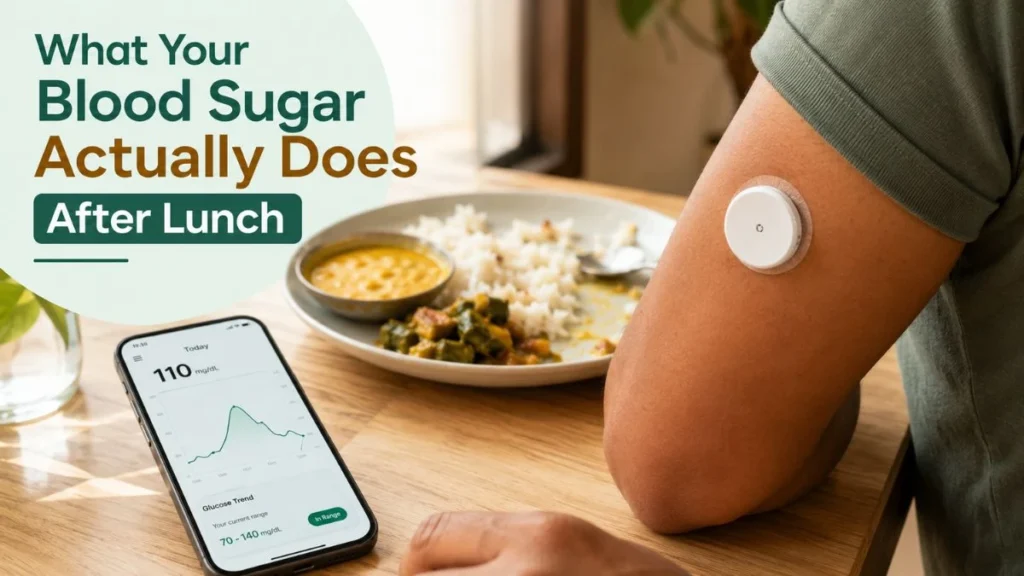
Three months ago, I stuck a small white sensor on the back of my upper arm, synced it to my phone, and started watching my blood sugar in real time. I don’t have diabetes. My HbA1c is 5.1%. My fasting glucose is consistently 85–90 mg/dL. By every standard medical measure, my blood sugar is fine.
So why did I spend ₹24,000 (~$290 USD) over 90 days wearing a CGM for non-diabetics — a continuous glucose monitor designed for people who don’t medically need one?
Because I wanted to answer one question: does knowing your real-time blood sugar data actually change how you eat, sleep, and feel — or is it just expensive wellness theatre?
After 90 days, six sensors, and roughly 12,960 individual glucose readings — here’s my honest answer. Some of it was genuinely life-changing. Some of it was a waste of money. And the difference between the two taught me something important about the line between useful data and health anxiety.
What a CGM Is — A 60-Second Explainer
A continuous glucose monitor is a small wearable sensor — roughly the size of a ₹2 coin — that you stick on your arm. A tiny filament sits just under the skin, measuring glucose levels in your interstitial fluid (the fluid between your cells) every 1–5 minutes. The data syncs wirelessly to your phone.
Originally designed for diabetic patients who need to track blood sugar constantly, CGMs have gone mainstream in 2025–2026. Companies like Ultrahuman, Vively, Levels, and January AI now market them directly to healthy people as “metabolic health” devices.
The promise: see how your body responds to food in real time, optimise your diet for stable energy, and prevent future metabolic disease.
The reality: more complicated than the marketing suggests. But not without value. Let me explain.
Lesson 1: Your Blood Sugar Response to Food Is Weirdly Personal
This was the single most useful thing I learned from wearing a CGM as a non-diabetic. The glycemic index — that universal chart that says white rice is “high GI” and oats are “medium GI” — is a population average. Your body doesn’t care about population averages.
A landmark 2015 study in Cell by Zeevi et al. tracked 800 people with CGMs and found that individual blood sugar responses to identical foods varied by up to 60% (PubMed: 26590418). One person spiked from bread but not from bananas. Another was the exact opposite. Same food, radically different metabolic response.
My own data confirmed this in ways I didn’t expect:
- White rice alone (150g, no accompaniment) → spike to 165 mg/dL, crash to 72 mg/dL within 90 minutes. This is the meal that was destroying my afternoons.
- White rice + dal + ghee + vegetable (same 150g rice, same meal timing) → peak at 128 mg/dL, gentle return to baseline. No crash. No fog.
- Oats with banana and honey (the “healthy breakfast” I’d been eating for years) → spike to 158 mg/dL. Higher than I expected. Higher than my dal-rice lunch.
- Idli with sambar (fermented rice batter) → peak at only 118 mg/dL. The fermentation appeared to slow the glucose absorption significantly.
Creatine for Women: 7 Evidence-Based Benefits Most Women Don’t Know About
Lesson 2: The 3 PM Energy Crash Isn’t “Just Tiredness” — It’s a Glucose Pattern
For years, I’d hit a wall at roughly 3:00–3:30 PM. Brain fog. Eyelid weight. Difficulty concentrating. I assumed it was just a natural afternoon dip. Everyone has that, right?
The CGM showed me exactly what was happening. My lunch — typically rice with a simple vegetable curry, eaten quickly at my desk — was causing a glucose spike to 155–170 mg/dL, followed by a reactive drop to 68–75 mg/dL roughly 90–120 minutes later. That drop below my fasting baseline is called reactive hypoglycemia. And it maps precisely onto the brain fog, the fatigue, and the sudden craving for chai and biscuits at 3 PM.
Once I understood the mechanism, the fix was simple: add protein to lunch (a boiled egg, some paneer, a glass of buttermilk), eat slower, and include a fat source. My afternoon crashes reduced by roughly 80% within a week. Not eliminated entirely — I still have slow afternoons — but the debilitating, can’t-think fog disappeared.
This single insight was worth the entire ₹24,000 investment. I mean that literally. The productivity I recovered in afternoon hours alone paid for the sensors.
Lesson 3: Sleep Wrecks Your Blood Sugar — And CGM Proves It
I knew sleep mattered. I didn’t know it mattered this much for blood sugar. And the CGM made it impossible to ignore.
After a night of 7.5+ hours of sleep, my fasting glucose was consistently 82–88 mg/dL. After a night of fewer than 6 hours? 95–105 mg/dL. Same person. Same body. Same dinner. The only variable was sleep duration — and it moved my fasting glucose by 15–20 mg/dL.
I now treat sleep as a metabolic health intervention, not a lifestyle luxury. That reframe came directly from wearing a CGM.
Lesson 4: Meal Timing Matters Almost as Much as Meal Content
Same dal-rice meal, eaten at 12:30 PM → peak glucose 125 mg/dL. Same dal-rice meal, eaten at 9:30 PM → peak glucose 148 mg/dL. I tested this four times. The pattern held every time.
Late-night eating produced higher glucose spikes from identical food. The difference wasn’t small — it was a 15–20% increase in peak glucose, consistently. A 2020 study in The Journal of Clinical Endocrinology & Metabolism confirmed this: eating the same meal four hours later in the day resulted in significantly higher glucose excursions, likely due to reduced insulin sensitivity in the evening.
What Happens When You Stop Ozempic? 5 Proven Effects and What to Do
Lesson 5: A CGM for Non-Diabetics Can Create Anxiety — And That’s the Part Nobody Talks About
Here’s my controversial take, and I’m going to be honest about it: by month three, the CGM was making me anxious about food.
I started avoiding fruit because it spiked my glucose. I started feeling guilty about rice. I’d check my phone after every meal to see “how I did.” I caught myself mentally grading my food choices — “good spike” versus “bad spike” — in a way that felt uncomfortably close to disordered thinking.
And I’m someone who doesn’t have a history of eating disorders. For someone who does, I can see how real-time glucose monitoring could become genuinely harmful.
A 2023 commentary in The Lancet Diabetes & Endocrinology raised exactly this concern — that CGM use in non-diabetics may “promote orthorexic tendencies and food anxiety in individuals who have no medical need for glucose monitoring” (PubMed: 37121235). The authors specifically warned about the wellness industry marketing metabolic fear to healthy people.
I took the sensor off after 90 days. I kept the lessons. I didn’t keep the monitoring. And I think that’s the right approach for most people.
CGM Options for Non-Diabetics: Cost and Feature Comparison
| Device / Platform | Sensor | Sensor Life | Monthly Cost (INR / USD) | App Quality |
|---|---|---|---|---|
| Abbott FreeStyle Libre 3 | FreeStyle Libre 3 | 14 days | ₹7,000–9,000 / $85–110 | Basic — medical-focused |
| Ultrahuman M1 | FreeStyle Libre | 14 days | ₹5,999–7,999 / $73–97 | Excellent — lifestyle scoring, meal logging |
| Dexcom G7 (via platforms) | Dexcom G7 | 10 days | ₹9,000–12,000 / $110–145 | Strong — real-time alerts |
| Vively | FreeStyle Libre | 14 days | ₹5,500–7,500 / $67–91 | Good — food pairing insights |
| Standalone blood glucose meter | Fingerstick strips | Per test | ₹500–800 / $6–10 | None — manual logging needed |
Note: Prices reflect Indian market rates as of mid-2026. Most CGM platforms for non-diabetics are subscription-based. The standalone glucose meter is included for cost comparison — it won’t give continuous data but can spot-check post-meal readings at a fraction of the cost.
CGM vs. Blood Test: Accuracy and What Each Actually Tells You
A question I get asked constantly: “Is a CGM as accurate as a blood test?” Short answer: no. But that’s not the right question.
What a blood test tells you: Your fasting glucose and HbA1c on the morning you got tested. A single snapshot. Useful for diagnosis. Useless for understanding post-meal patterns.
Modern CGMs like the FreeStyle Libre 3 have a MARD (mean absolute relative difference) of about 8–9%. For non-diabetics tracking patterns rather than making insulin dosing decisions, this is more than adequate. You don’t need to know your glucose is exactly 134 mg/dL. You need to know that your lunch caused a big spike and your dinner didn’t. The CGM is excellent at that.
My Honest Verdict: Who Should Actually Try a CGM for Non-Diabetics
After 90 days, here’s my direct recommendation — and I’m going to be specific because vague advice helps nobody.
A CGM is genuinely worth trying if:
- You have unexplained energy crashes, brain fog, or mood swings after meals — and want to identify the specific foods causing them
- You have a family history of type 2 diabetes and want to understand your personal glucose responses before problems develop
- You’re prediabetic (HbA1c 5.7–6.4%) and want detailed data to guide dietary changes alongside your doctor’s treatment plan
- You’re genuinely curious about metabolic health and can afford 2–4 weeks of sensors without financial stress
A CGM is probably not worth it if:
- Your blood sugar is normal and you have no symptoms — you’ll likely spend ₹8,000+ confirming what your ₹300 blood test already told you
- You have a history of disordered eating, food anxiety, or orthorexia — continuous monitoring may worsen these patterns
- You want a long-term monitoring solution — for most non-diabetics, 2–4 weeks of data provides 90% of the actionable insights. Wearing one for months is diminishing returns
- You can’t afford it without stress — this is a wellness luxury, not a medical necessity, for healthy people
My recommendation: wear a CGM for 2–4 weeks. Log your typical meals. Learn your personal patterns. Then stop. Take the data with you. Leave the sensor behind. The insights last longer than the subscription. What Happens When You Stop Ozempic? 5 Proven Effects and What to Do
When to See a Doctor About Your Blood Sugar
A CGM is not a diagnostic tool for non-diabetics. See your doctor if you notice any of the following — whether from CGM data or symptoms:
- Fasting glucose consistently above 100 mg/dL on your CGM (may indicate prediabetes — confirm with a blood test)
- Post-meal glucose regularly exceeding 180 mg/dL and not returning to baseline within 2–3 hours
- Frequent reactive hypoglycemia — drops below 60 mg/dL with symptoms like shaking, sweating, or confusion
- Excessive thirst, frequent urination, unexplained weight loss — classic diabetes warning signs
- Family history of type 2 diabetes combined with any of the above patterns
A CGM reading is not a diagnosis. Interstitial glucose can read 10–15% differently from blood glucose. If your CGM data concerns you, get a proper fasting blood glucose test and HbA1c from your doctor. A ₹300 lab test is the medical standard, not a ₹4,000 sensor.
How to Start Today — 3 Practical Steps
If you want to try a CGM:
- Start with 2 weeks, not 3 months. Buy one FreeStyle Libre sensor from a pharmacy (₹3,500–4,500) or subscribe to Ultrahuman for one month (₹5,999). Log every meal in the app during those 2 weeks. Eat your normal diet — don’t try to “eat clean” for the test. You want to see your real patterns, not your ideal ones.
- Test your problem meals specifically. If you crash at 3 PM, wear the CGM during a normal work week and eat your typical lunch. See what happens at 90 minutes post-meal. Then try the same meal with added protein or fat. Compare the graphs. That comparison is worth more than weeks of ambient monitoring.
- Share the data with your doctor. CGM data is a conversation starter, not a self-diagnosis tool. Bring your 2-week glucose report to your next check-up. Let your doctor interpret it in the context of your full health picture.
If you don’t want to spend on a CGM but are curious about blood sugar:
Buy a basic glucometer (₹800–1,200 / ~$10–15 USD) and a box of 50 test strips (₹400–600 / ~$5–7 USD). Check your glucose before and 60 minutes after your most common meals for one week. It’s not continuous data. But it’ll show you which meals spike you and which don’t — for about one-tenth the cost of a CGM. Sometimes the low-tech answer is the right answer.
Data Is Useful. Obsession Is Not.
Here’s what 90 days of wearing a CGM for non-diabetics taught me in one sentence: your blood sugar responds to food, sleep, stress, and timing in ways that are highly personal and largely invisible without measurement — but once you’ve seen the patterns, you don’t need to keep measuring them.
The five lessons I learned — food pairing matters more than food avoidance, afternoon crashes have a specific glucose signature, sleep is a metabolic intervention, meal timing changes glucose response, and too much data creates food anxiety — are insights I carry every day. Without the sensor.
The metabolic health tracking trend is real. The CGM data is genuinely valuable for a finite learning period. And the marketing machine trying to convince healthy people they need continuous glucose monitoring forever is — in my opinion — solving a problem it partly created.
Learn your patterns. Change what matters. Then trust your body. It was regulating your blood sugar long before a sensor existed — and it’ll keep doing it after you take one off.
Have you tried a CGM without having diabetes? I’m curious — what surprised you most about your data? And did you keep wearing it, or did you stop?
Frequently Asked Questions
Do non-diabetics need a CGM?
Most non-diabetics do not medically need a CGM. A healthy body regulates blood sugar effectively on its own. Wearing a CGM for a short period (2–4 weeks) can provide genuinely useful insights — particularly about how specific foods affect your blood sugar, why you experience energy crashes after certain meals, and whether your post-meal glucose spikes are within healthy ranges. The key question is whether those insights are worth the cost — roughly ₹4,000–8,000 or $50–100 USD per month for the sensors. For most healthy people, a short exploratory period is more valuable than continuous long-term monitoring.
Which foods spike blood sugar the most?
Common high-spike foods include white rice (especially eaten alone without fat or protein), white bread, fruit juice, sugary breakfast cereals, and potatoes. Glycemic responses are highly individual — the same food can spike one person and barely affect another. Research published in Cell (Zeevi et al., 2015) showed that individual blood sugar responses to identical foods varied by up to 60%. This is exactly why CGMs for non-diabetics have become popular — they reveal your personal response rather than relying on generic glycemic index charts.
How accurate are CGMs compared to blood tests?
CGMs measure glucose in interstitial fluid (between cells), not directly in blood. This creates a 5–15 minute lag compared to fingerstick blood glucose readings, and accuracy can vary by 10–15% from actual blood values. Modern CGMs like the Abbott FreeStyle Libre 3 and Dexcom G7 have a MARD (mean absolute relative difference) of about 8–9%, which is clinically acceptable. For non-diabetics using CGMs for general metabolic health tracking, this accuracy is more than sufficient to identify trends, spikes, and patterns — even if individual readings may not be perfectly precise.
Can a CGM help with energy crashes and brain fog?
Yes, this is one of the most practical uses of a CGM for non-diabetics. Energy crashes and brain fog often correlate with reactive hypoglycemia — a blood sugar spike followed by a rapid drop below baseline. A CGM can show you exactly which meals or snacks trigger this pattern. In my 90-day experiment, I discovered that white rice eaten alone caused a spike to 165 mg/dL followed by a crash to 72 mg/dL within 90 minutes — matching exactly when I would feel foggy and tired after lunch. Adding protein and fat to the same rice meal reduced the spike to 128 mg/dL with no crash.
How much does a CGM cost for non-diabetics in India?
In India, the most commonly available CGM for non-diabetics is the Abbott FreeStyle Libre, which costs approximately ₹3,500–4,500 per sensor (each sensor lasts 14 days). That works out to roughly ₹7,000–9,000 per month ($85–110 USD). Metabolic health platforms like Ultrahuman and Vively offer CGM subscription services with app-based analysis for ₹5,000–8,000 per month. These costs are not covered by most Indian health insurance plans since CGMs are not medically indicated for non-diabetics. A more cost-effective approach is to use a CGM for 2–4 weeks to gather data, then apply those learnings without continuous monitoring.
References
- Zeevi, D., et al. (2015). “Personalized Nutrition by Prediction of Glycemic Responses.” Cell, 163(5), 1079-1094. PubMed: 26590418
- Buxton, O. M., et al. (2010). “Sleep restriction results in reduced insulin sensitivity.” Annals of Internal Medicine, 153(7), 435-441. PubMed: 20921542
- Klonoff, D. C. (2023). “Continuous Glucose Monitoring in Nondiabetic Individuals.” The Lancet Diabetes & Endocrinology. PubMed: 37121235
- Shah, V. N., et al. (2019). “Performance of a Factory-Calibrated, Real-Time Continuous Glucose Monitoring System.” Diabetes Technology & Therapeutics, 21(8), 428-434.
Continuous glucose monitors are medical devices originally designed for diabetic patients. Using a CGM without a medical indication is a personal choice, not a medical recommendation. CGM data should not be used for self-diagnosis. If your CGM readings concern you, consult your doctor and confirm with standard blood glucose testing.
This article mentions specific brands (Abbott FreeStyle Libre, Ultrahuman, Dexcom, Vively) for informational purposes only. These are not endorsements or sponsored recommendations.
